

The carbon cost of feed: rethinking layer nutrition for sustainability
Published on : 21 Apr 2026
 Speaking at the World Egg Conference, Dr Ovsanna Mikhaylovskaya, an independent poultry consultant from Latvia, set out a clear argument that the future of sustainable egg production will be shaped as much by what happens in the feed bin and the hen’s gut as by wider debates around energy, emissions and regulation. Her presentation, Sustainable nutrition: gut health factor, focused on the increasingly important link between layer nutrition, flock resilience and the carbon profile of egg production.Feeding strategies in modern egg production are increasingly shaped by a convergence of economic pressure, environmental scrutiny and the biological limits of the laying hen. What was once considered a routine input has become the central lever through which producers balance profitability, performance and sustainability. The conversation is no longer simply about what to feed, but how efficiently that feed is converted into eggs under increasingly complex production conditions.Rising costs across feed, energy and veterinary care continue to compress margins, while retailers and regulators apply growing pressure on producers to demonstrate measurable progress on carbon reduction, welfare and antibiotic use. Sustainability has moved beyond industry rhetoric and into the core of commercial decision making. It now sits alongside profitability and efficiency as a defining metric of success.Within this shifting landscape, the egg sector retains a relatively favourable position compared with other livestock systems in terms of emissions per unit of output. That advantage, however, does not remove the need for further gains. The production chain remains multifaceted, spanning feed production, pullet rearing, laying performance, egg handling and manure utilisation. Each stage contributes to overall emissions, but not equally.Feed dominates both cost and carbon. It represents the largest single input in egg production and the most significant contributor to the sector’s environmental footprint. This dual impact places feed efficiency at the centre of any meaningful sustainability strategy. Improvements in feed conversion deliver immediate economic benefits while simultaneously reducing the resources required to produce each egg.Dr Mikhaylovskaya’s central point was that sustainability discussions in egg production too often default to energy or infrastructure, when feed should be receiving equal, if not greater, attention. In practical terms, that means looking far more closely at nutrient utilisation, digestive stability and the biological efficiency of the hen. Feed is not just the main cost centre. It is also where the greatest opportunity exists to reduce waste and improve environmental performance.Genetic progress has already pushed the boundaries of what is possible. Modern layers are capable of producing substantially more eggs over longer laying cycles while consuming less feed per unit of output. Birds that once produced around 270 eggs per cycle are now achieving close to 500 eggs over extended production periods. These gains have been achieved alongside improvements in feed efficiency, but they have also increased the physiological demands placed on the bird.High performing flocks require consistent nutritional support to maintain output and resilience. The margin for error has narrowed, particularly as external pressures such as heat stress, variable raw material quality and evolving disease challenges become more pronounced. Feed formulation is no longer a static process. It must respond dynamically to changing conditions while maintaining stability within the flock.Climate variability has introduced a new layer of complexity. Harvest quality can no longer be predicted with certainty, leading to greater inconsistency in feed raw materials. Heat stress events are becoming more frequent, placing additional strain on birds and reducing feed intake at critical points in the production cycle. These factors combine to create fluctuations in performance that can be difficult to control through traditional feeding approaches alone.At the same time, disease pressure is evolving. Changes in pathogen dynamics, influenced by environmental factors and global movement patterns, are increasing the risk of outbreaks and subclinical challenges. Birds are often required to maintain high levels of production while coping with these stressors, making resilience a key priority.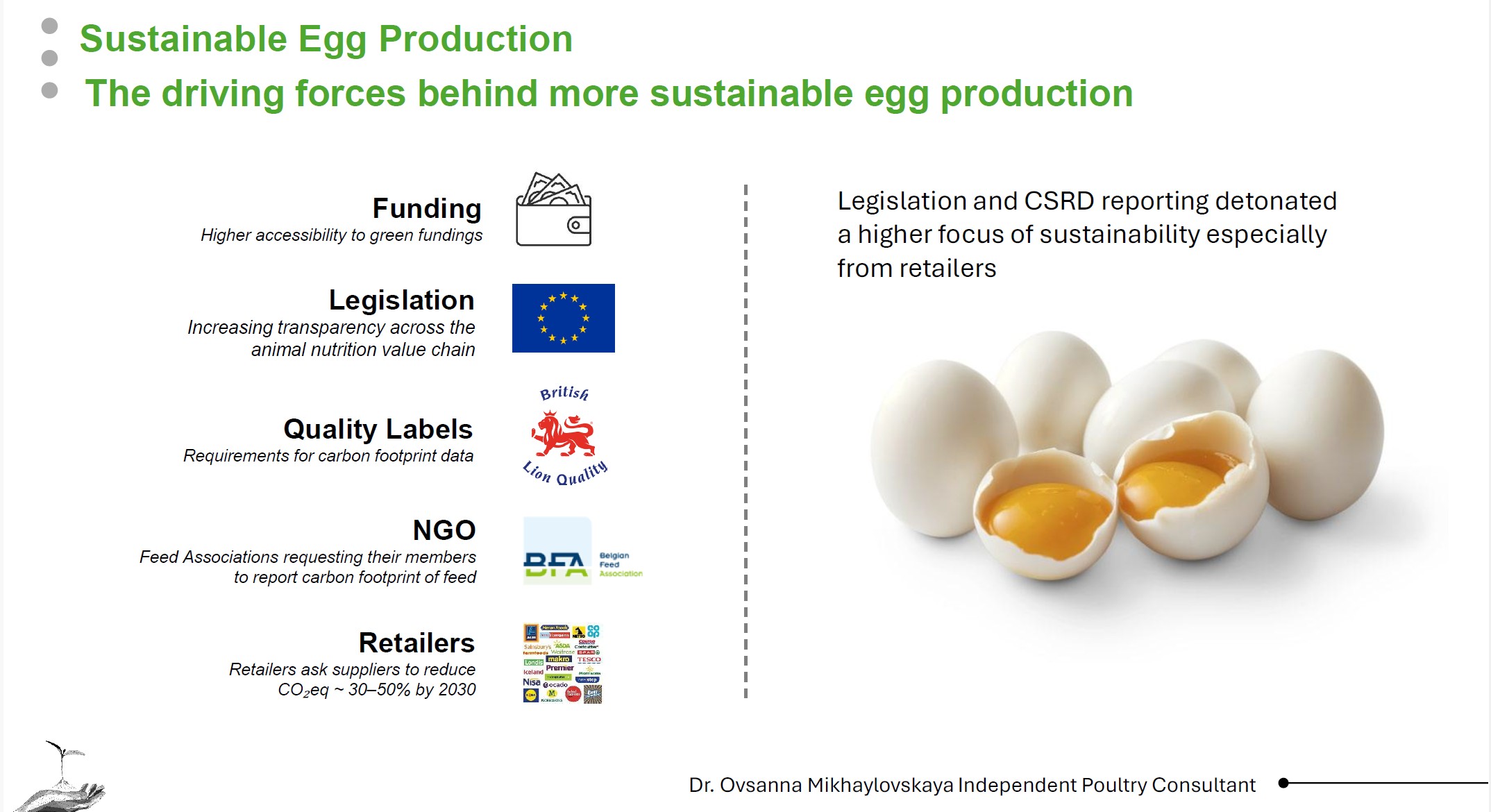
Retailers are demanding producers reduce their carbon
Gut health has emerged as a central factor in managing this balance. The digestive system plays a critical role in nutrient absorption, immune response and overall bird stability. When gut function is compromised, even slightly, the impact on feed efficiency and production can be significant. Reduced nutrient uptake leads to poorer conversion, while imbalances in the microbiota can increase susceptibility to disease and stress.These effects are not always immediately visible. Subtle reductions in feed efficiency or slight increases in mortality can accumulate over time, resulting in hidden losses within the system. Addressing these inefficiencies requires a more targeted approach to nutrition, one that focuses not only on meeting basic requirements but on optimising the internal environment of the bird.A significant theme in Dr Mikhaylovskaya’s presentation was the shift away from routine antibiotic use and the need to support flock health through prevention rather than reaction. Across global markets there is a clear move towards limiting antibiotic interventions, driven by regulatory frameworks, consumer expectations and concerns around antimicrobial resistance. Producers are therefore seeking alternative strategies to maintain flock health and performance without undermining commercial output.Nutritional interventions aimed at supporting the microbiota have gained traction in this context. Phytogenic and botanical feed additives are increasingly being incorporated into feeding programmes as part of a broader strategy to enhance gut function. Derived from plant extracts, herbs and essential oils, these substances are used to stabilise digestion, improve nutrient utilisation and support the natural resilience of the bird.Their role is not to replace core management practices but to complement them. Dr Mikhaylovskaya was careful to stress that these products are tools, not miracles. They are not medicines, not shortcuts for poor management and not overnight solutions. Their value lies in consistent use as part of a long term feeding strategy, particularly in large scale operations, multi age systems, high producing flocks, heat stress conditions and situations where feed quality may vary.When applied within a well managed system, they can contribute to more stable feed intake, improved digestion and better overall performance. The benefits are cumulative rather than immediate, reflecting their function as part of a long term approach to flock stability.Improvements in feed efficiency are often the first measurable outcome. Even small reductions in feed consumption, when maintained across an entire flock, translate into significant cost savings. Enhanced nutrient absorption also supports egg production, with incremental gains in output and improvements in egg mass contributing to overall returns.Mortality is another area where gains can be realised. Birds with more stable gut function and improved resilience are better able to cope with environmental and nutritional stressors. Lower mortality not only improves productivity but also reflects a more robust and consistent production system.The presentation also pointed to commercial trial data supporting this line of thinking. Flocks receiving phytogenic or botanical products recorded lower feed consumption, improved egg production and reduced mortality compared with control flocks. For producers, those kinds of changes are meaningful not because they sound dramatic on paper, but because they accumulate across a house, a site and a full production cycle.These performance gains have a direct link to sustainability. Improved feed conversion reduces the volume of raw materials required, lowering the environmental impact associated with feed production. Better nutrient utilisation leads to reduced excretion of nitrogen and phosphorus, which in turn decreases the pressure on manure management systems. More consistent production reduces the number of downgraded or lost eggs, minimising waste across the supply chain.The relationship between efficiency and sustainability becomes increasingly clear when viewed through this lens. Reducing waste at every stage of production delivers both environmental and economic benefits. The focus shifts from doing more to doing better with the resources already in use.It is important to recognise that feed additives are not a shortcut to improved performance. Their effectiveness depends on consistency, quality and integration within the wider management system. Poor biosecurity, inadequate housing conditions or inconsistent feeding practices cannot be compensated for through nutritional interventions alone.A holistic approach remains essential. Biosecurity continues to underpin disease prevention, while vaccination programmes and monitoring systems support early detection and response. Advances in technology are beginning to provide new tools for tracking flock health and performance, enabling more precise adjustments to feeding strategies.Nutrition sits at the intersection of these systems. It supports immune function, influences behaviour and plays a role in how birds respond to stress. As production systems become more complex, the ability to fine tune feeding programmes in response to changing conditions will become increasingly important.The concept of sustainability within egg production is often framed in environmental terms, but its foundation lies in operational efficiency. Without stable and profitable systems, investment in improved practices becomes difficult to sustain. The alignment of economic and environmental objectives is therefore critical.Feed efficiency offers one of the most direct routes to achieving this alignment. By improving how feed is utilised, producers can reduce costs, lower emissions and enhance overall system stability. The cumulative effect of incremental improvements across feeding, management and genetics defines the trajectory of the industry.Looking ahead, the emphasis on precision feeding is likely to intensify. Greater use of data, improved understanding of nutrient interactions and continued development of feed additives will shape the next phase of progress. Producers who are able to integrate these elements effectively will be better positioned to maintain performance under increasingly variable conditions.Operational focus is shifting towards tighter control of feed formulation, closer monitoring of flock performance and more responsive management systems. Feed conversion, mortality, egg quality and uniformity are being tracked with greater accuracy, providing the data needed to refine feeding strategies in real time.In practical terms, the message from Dr Ovsanna Mikhaylovskaya’s World Egg Conference presentation was that feed now sits at the centre of decision making. From ingredient sourcing to additive inclusion and feeding regimes, every aspect of nutrition is being evaluated for its impact on both performance and sustainability. The margin for inefficiency is narrowing, and the ability to extract maximum value from each tonne of feed is becoming a defining factor in long term success.