

Signify says poultry lighting must start reacting to the flock
Published on : 24 Sep 2026
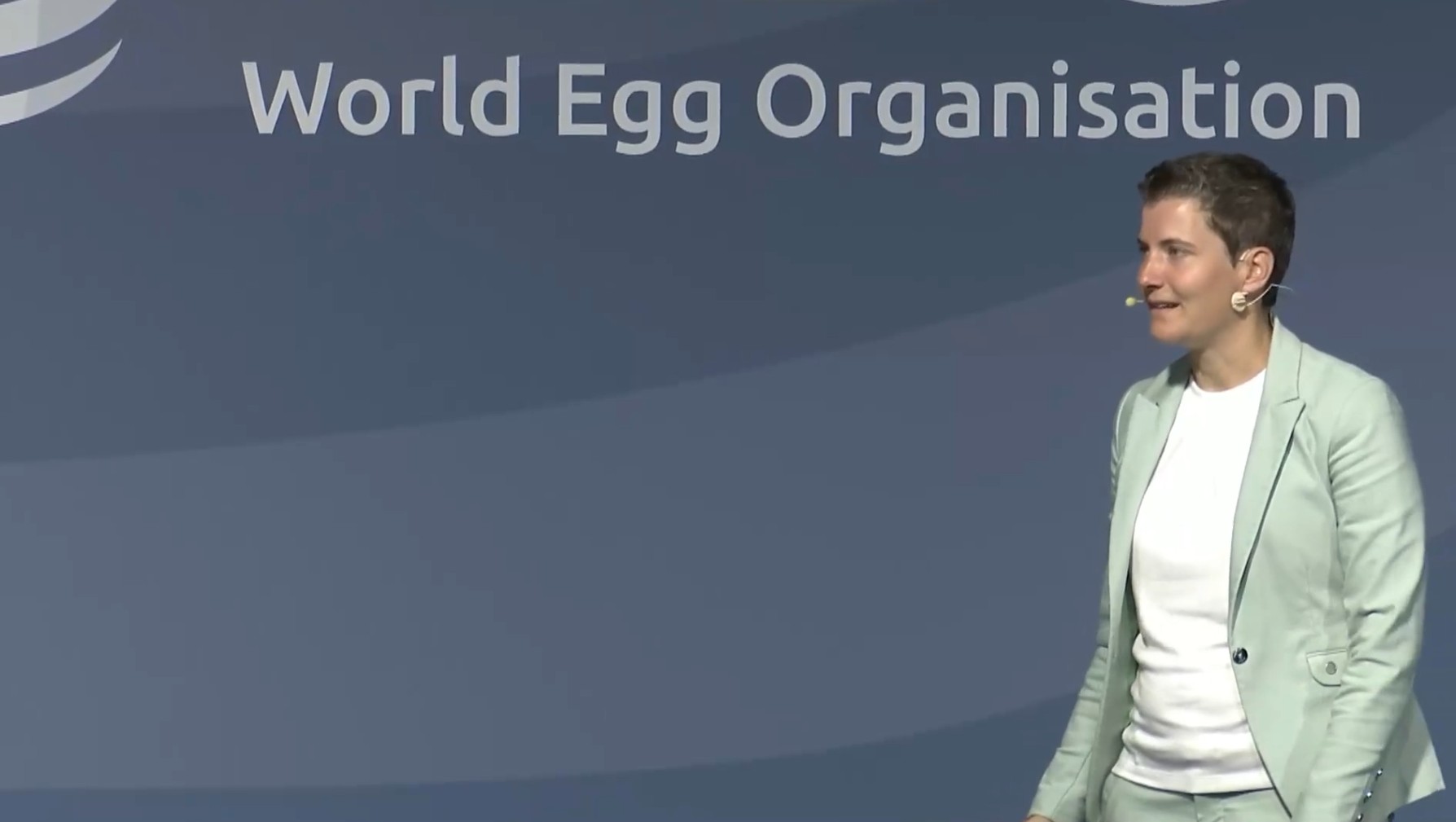
Erica Bongers, animal lighting application specialist at Signify in the Netherlands,
Lighting systems need to sense what the flock is doing and change in response, not just run a fixed schedule, delegates at the World Egg Organisation Global Leadership Conference in Singapore were told.Erica Bongers, animal lighting application specialist at Signify in the Netherlands, said schedule, spectrum, intensity and distribution were the fundamentals of poultry lighting. She called them the start rather than the finish, and said the question now was how to use light intentionally. She asked producers whether they knew for sure that the light in their barn was doing what it had to do, since nobody is in the barn 24 hours a day.She explained the idea through her motorcycle. Her father rode with a paper map on his tank bag, and her first bike used GPS on her phone. The new one she bought last spring has built-in GPS, an automatic gearbox and cruise control that limits her speed "so I don't get a fine". Her father had to watch the map, the road and the gears. She said she only has to watch a screen and can enjoy the road, and that farmers should get the same from their lighting. "Lighting is more than just on, off. It's more than just to have the birds in the barn and bring them from A to B as quickly as possible," she said.Right light, right timeMs Bongers said intentional lighting begins with purpose: the right light at the right time for the right outcome. Birds looking for feed and water need bright light, and birds that need to sleep need dimmed light. She said timing mattered because young hens have to be trained to go into the system, find the nest and move up to the top to roost at the right time. If the goal is quiet, relaxed birds, the manager has to work back from that to the time of day and check the barn has the right light for it.She described a laying hen's day in four parts. In the morning the birds should wake slowly with a gradual sunrise, and not with "an alarm that goes off". In the early day they need calm, consistent conditions to find the nest and lay. During the daytime the light should help them find feed and water, explore and stay active. In the evening a gradual sunset lets them settle and move into the system for the night. She said every part of the flock's day called for a different lighting response.She said she would not give lux levels or hours of light. These depend on whether the barn gets daylight or is closed, whether it houses broilers or layers, and on genetics, with white and brown birds kept around the world. "I just want you to focus on the question, are you sure that your light is supporting your bird?" she said.A management toolMs Bongers said lighting was no longer infrastructure and was becoming a management tool. Barns already have coloured lights, dynamic transitions, directional lighting and light recipes, with phone apps setting on and off times, lux intensity and dimming. She said the next step was a system that confirms what has happened in the barn and helps the manager make better decisions. "If you want to have a premium flock, you cannot use basic lighting," she said.Her example was birds crowding into one corner to use the same nests when there was room for all of them. Current light strips can already use white light with a little red to draw birds to an area and white with blue to move them away. A management tool would add a sensor, such as a camera, that sees too many birds in one corner, where they can suffocate for lack of fresh air. It would then shift the colour of the light slightly to move them out. "We already have the coloured lights, the strip lights in the system, but what we need is a sensor that reacts on it," she said.She said a management tool also had to confirm that the programme had run. A sunset may be scheduled, but nobody checks whether the lights actually go off. Birds still on the floor after sunset show something went wrong. The cause could be the lighting, the ventilation, or the water or feed system, such as a light that did not go off in one corner or too much airflow in one part of the barn. The manager needs that visibility to fix the problem, and she said the feedback could not take a week or a month. "You need to act immediately," she said.Sense, connect, act, learnMs Bongers said four technologies were shaping the future: sensors, connectivity, automation and data. Together they form a closed loop of sense, connect, act and learn. She said the technology already exists and gave Signify's Philips Hue home lighting as an example. When her phone joins her home Wi-Fi the lights come on, so she never comes home to a dark house, and the data would even show her partner whether she got home on time.In a poultry house, she said, a sensor could spot an area of the barn left empty by young birds and raise the light there slightly. The birds would then spread evenly within one or two hours, after which the light could return to the same level across the barn. The first time, the farmer has to tell the system which lux level he wants, and she said the loop is continuous and "not one time right".She said the many systems already in barns need to be connected. At present a farmer who wants to check the lux level or the current light recipe needs "five passwords, you need to log in on three systems". Signify has a lot of lighting knowledge but less about the other connected systems. She said she was at the conference looking for partners to build one platform where the farmer can see all his data.She described one example already in use, with four feed lines and eight sensor pans. A farmer noticed the pans on the right side of the barn were not emptying, so old feed sat in the line while new feed went in on the left and in the middle. Raising the light slightly on the right draws no more than 5 per cent of the birds to that side, which is enough to empty the pans and bring in fresh feed. The system then learns to lift the light on that side at the end of each day before the problem appears, "so now we never have old feed in the feed lines", she said.Ms Bongers said data could not replace the experienced farmer who stops at the barn door to listen before going in. "We cannot replace the farmer, but we can help him," she said. Microphones can listen in the barn 24 hours a day, so the farmer knows when he wakes up which farm to visit first.On heat stress, she said rising temperatures make birds more active and vocal. The lighting can then adjust its intensity and distribution while the environmental controls are alerted. She said the result would be reduced stress, better welfare and more consistent flock performance, "so less mortality and cost saving".She said feed, water and climate are all adjusted over a hen's lifetime, and asked why lighting is not. Young birds need blue-green light to keep them calm, and laying hens need white light with red to stimulate lay.Ms Bongers asked delegates to go into their barns the following week and check whether all the lights were working. She told them to consider what time of day it was, what the birds should be doing, and whether the light was doing what it was supposed to do.