
Salmonella Control: UK leads Europe, but longer laying cycles signal new risk
Published on : 4 Jul 2026
 British egg producers have built one of the strongest Salmonella control records in Europe, but the extended laying cycles now common across the industry are creating a fresh vulnerability that needs addressing, delegates at Elanco's AviPro Salmonella Duo launch event heard last week.Speaking to a packed room of vets, producers and packers, Doris Mueller-Doblies, Global Food Safety Consultant at Elanco Austria GmbH, took the audience through four decades of data charting the rise, fall and recent resurgence of Salmonella in the laying flock – and made clear that Britain's response to the crisis of the late twentieth century has left it in a markedly stronger position than most of its European neighbours."You as an industry have achieved a lot with regards to Salmonella control in the poultry sector," she told delegates. "That obviously has an impact on public health, reducing the number of human cases, and the UK has been, and is, at the forefront."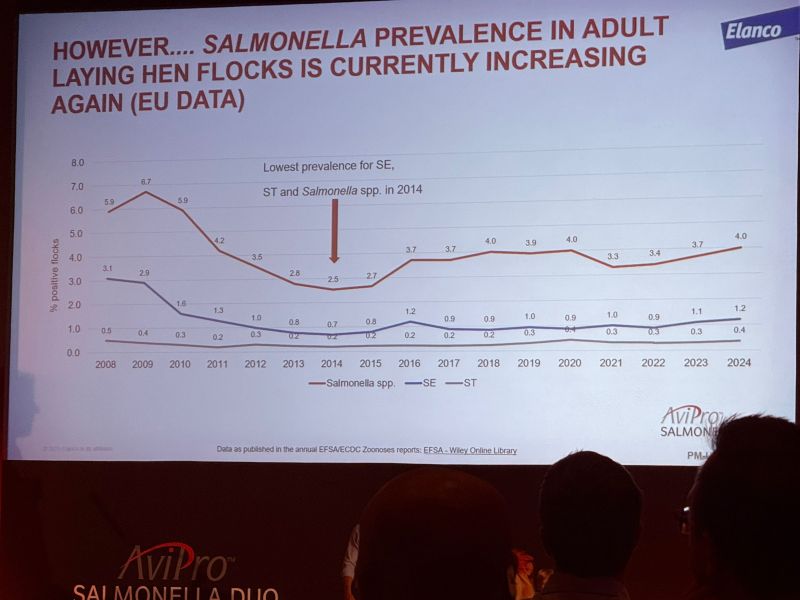
In the EU salmonella prevalence in adult flocks is increasing
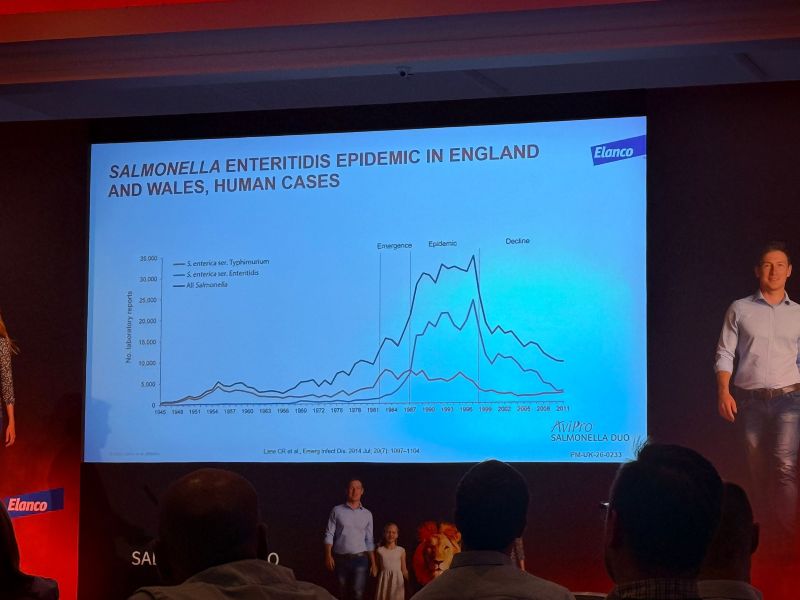
Mueller-Doblies opened with a chart tracing the Salmonella Enteritidis epidemic in England and Wales from 1945 to 2011, showing human laboratory reports climbing from a low, flat baseline through an "emergence" phase in the early 1980s to an "epidemic" peak of more than 30,000 reported cases a year in the 1990s, before a sharp decline followed the industry’s adoption of the Lion Code. The European response, she noted, lagged the British one by roughly a decade. "It took basically ten years longer than the Lion Code, even though we had the regulation back in 2003," she said, adding that agreement across a growing number of member states inevitably slows collective action.To illustrate the public health payoff of control measures, she presented comparison data from the European Food Safety Authority (EFSA) and European Centre for Disease Prevention and Control (ECDC) for 2004 against 2019 – deliberately excluding the Covid-affected years – showing confirmed human Salmonella cases falling from 192,703 to 87,923 across the countries covered, a reduction of 54%. Over the same period Campylobacter cases rose from 183,961 to 220,682. "This can’t be a coincidence," Mueller-Doblies said. "This was clearly due to the Salmonella control measures. At the same time, Campylobacter cases have increased… controlling Campylobacter is a frustrating business, because all the non-specific measures – biosecurity, pest control, cleaning and disinfection – don’t really have an impact on it."
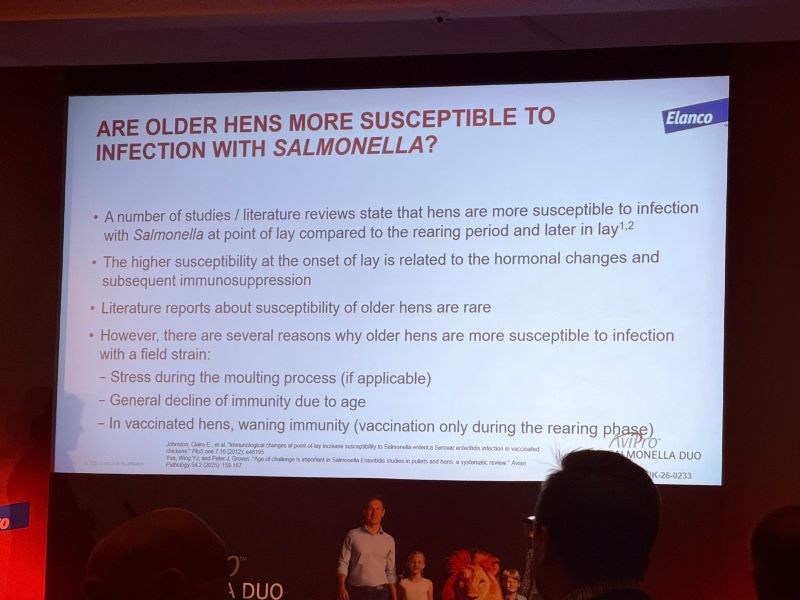
Are older hens more susceptible to infection with salmonella
Flock-level prevalence data told a similar story of hard-won progress now under strain. Comparing the EU baseline survey of 2004/05 with 2024 figures, Mueller-Doblies said flock prevalence for all Salmonella serovars had fallen from around 30% to roughly 4%, and for Enteritidis and Typhimurium combined from 20% to about 1.6% – "a more than 90% reduction". But the trend since the low point of 2014, when EU prevalence for regulated serovars stood at 2.5%, has been upward: by 2024 that figure had climbed back to around 4.0%, with Enteritidis prevalence rising from 0.7% to 1.2% and Typhimurium from 0.2% to 0.4%. "We are seeing this increase," she said. "We should really not deny that, and we need to be aware of it."Britain’s own numbers, drawn from Defra’s annual Salmonella in Animals and Feed report, put the country in a considerably stronger position. GB prevalence of Enteritidis and Typhimurium combined stood at just 0.24%, against Northern Ireland’s 0.12%, comparing favourably with France (2.568%), the Netherlands (3.954%) and Poland, officially at 2.091%. Mueller-Doblies made clear she wasn’t entirely convinced by that last figure. "I honestly believe that Poland has a lot more Enteritidis than what is shown here," she said, "though I hope I’m not offending anyone." Of the UK’s own numbers, she was unequivocal: "The British flocks are significantly lower. For me this is clearly due to the fact that you have stronger measures in the UK based on the Lion Code."A closer look at the GB trend line, however, showed the same gentle creep upward seen across the continent. Domestic figures for SE (Salmonella Enteritidis) and ST (Salmonella Typhimurium)-positive laying hen flocks show Enteritidis-positive flock numbers rising from a low base in 2016 to a peak of 14 flocks in 2019, before easing back, while Typhimurium-positive flocks have followed a steadier upward path, reaching eight flocks in 2024 having been negligible a decade earlier. Mueller-Doblies said Typhimurium in particular deserved more attention than it typically receives. "Sometimes when I go to other countries in Europe, people tell me they don’t really see Typhimurium, it’s not causing an issue," she said. "It is there. It’s definitely there." She pointed to its association with wild birds, rodents and, to a lesser extent, the pig sector, adding: "The UK is, let’s say, in a more vulnerable position – you do have quite a lot of free-range flocks, and we know there’s a lot of Typhimurium in wildlife."
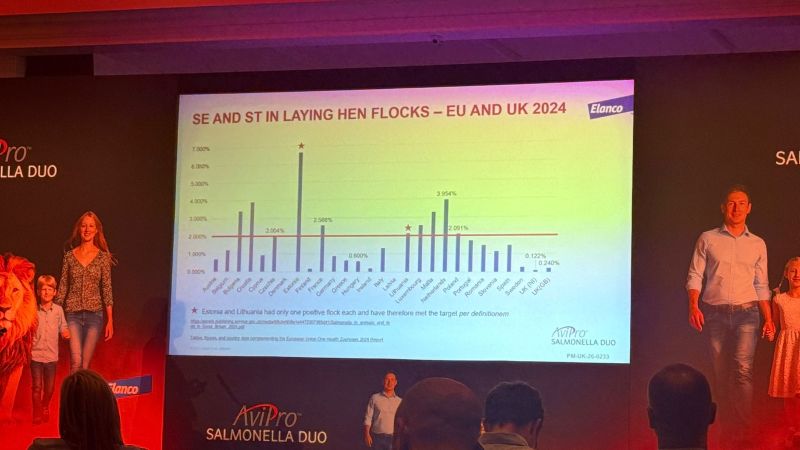
SE and ST in laying flocks - EU and UK
She also used EFSA figures to challenge the assumption that outdoor systems carry greater risk. Pie charts comparing housing systems showed the UK laying flock is 71% free-range plus a further 4% organic, compared with just 17% free-range and 7% organic across the EU as a whole – yet UK prevalence remains markedly lower. Scatter-plot analysis across member states showed flock prevalence falling as the percentage of hens in alternative and free-range systems rose. "It’s actually not a higher risk to have your hens outdoors," she said, while cautioning that farm size, flock numbers and the historic association of persistent Enteritidis with older cage infrastructure could all be contributing factors, alongside country-level variables such as climate, economy and attention to animal welfare.Turning to why the European-wide increase is happening at all, Mueller-Doblies set out a list of contributing factors rather than a single cause. Vertical transmission from infected breeding flocks was highlighted as a key driver, illustrated by EU data showing SE prevalence in adult breeding flocks rising from 0.31% in 2014 to 0.36% in 2019 and 0.53% in 2024. Incomplete vaccination programmes – for example, two doses administered during rear instead of three, or products from different manufacturers mixed outside their data sheet recommendations – were flagged as a specific concern in some European markets, though she noted the UK’s requirement to vaccinate strictly according to the product’s summary of characteristics puts it in a stronger position. Complacency around biosecurity and rodent control after years of good results was also cited, along with pressure on pullet availability and pricing driven by outbreaks of avian influenza and Newcastle disease on the continent. She was blunt about where that pressure leads: "People can’t source pullets, so they keep flocks in production – they keep Enteritidis-positive flocks in production, which under the Lion Code you’re not allowed to do. In most European countries they are allowed to do that. So they produce Class B eggs, and those eggs go into industry eggs." She warned against assuming liquid egg is automatically safe: "Don’t think that liquid egg is the same as pasteurised milk, where everything is dead. It’s not." An SE-positive flock left in production, she added, also raises the biosecurity risk of infection spreading to other houses on the same site: "If I have one Enteritidis-positive house on the farm and my other houses are negative, well, it’s only a matter of time for this infection to infect the other houses as well."
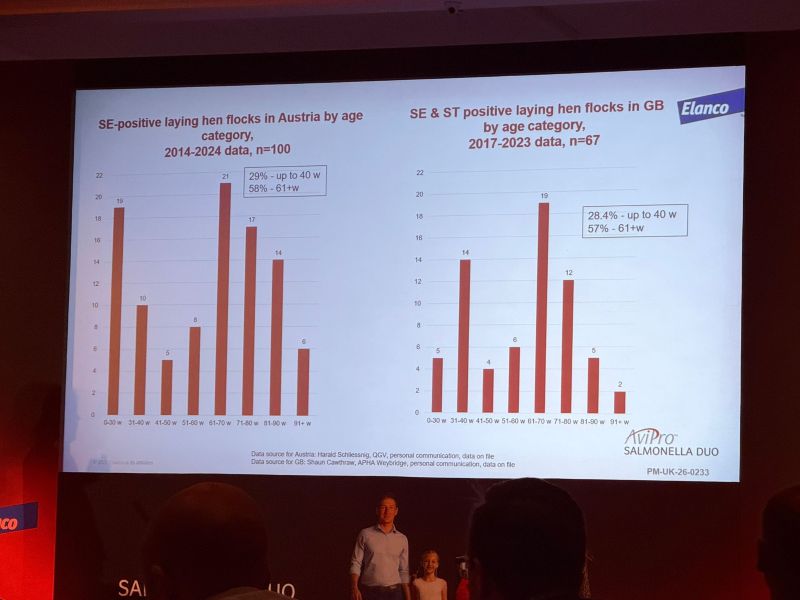
SE and ST positives in Austria and GB by age
The most striking material concerned flock age. Mueller-Doblies noted that while a number of studies point to hens being highly susceptible to Salmonella infection around point of lay – linked to hormonal changes and associated immunosuppression – literature on the susceptibility of older hens is comparatively rare, despite there being clear biological reasons to expect it, including the stress of moulting where practised, a general age-related decline in immunity, and waning vaccine protection in birds vaccinated only during rear.Reviewing published risk factor analyses, she said the most commonly identified drivers of flocks turning Salmonella-positive were the size of the farm and number of houses, the size of the flock itself, multi-age sites, caged systems, and obvious rodent control failures – but that only one study, from Spain, had specifically examined the age of the flock at the point of infection. That Spanish analysis of official monitoring data from 2015 to 2020 showed positive rates for Salmonella spp. rising steadily by age band – from 2.40% in flocks under 39 weeks to 4.90% in flocks over 83 weeks – with the gap for the regulated serovars SE/ST proportionally wider still, rising from 0.24% to 0.70%. "Twice as many flocks test positive for Salmonella spp. over 83 weeks of age compared to flocks under 39 weeks," she said. "For the target serovars, this difference is even higher."Independent data obtained from the Animal and Plant Health Agency (APHA) at Weybridge and Austria’s QGV poultry quality association reinforced the point closer to home. Flock counts covering Great Britain between 2017 and 2023, and Austria between 2014 and 2024, both showed a clear peak in SE/ST-positive flocks in the 61–70 week age band, with 57% of GB-positive flocks and 58% of Austrian-positive flocks aged 61 weeks or older at the point of detection. Only around 28–29% of positive flocks were found before 40 weeks.
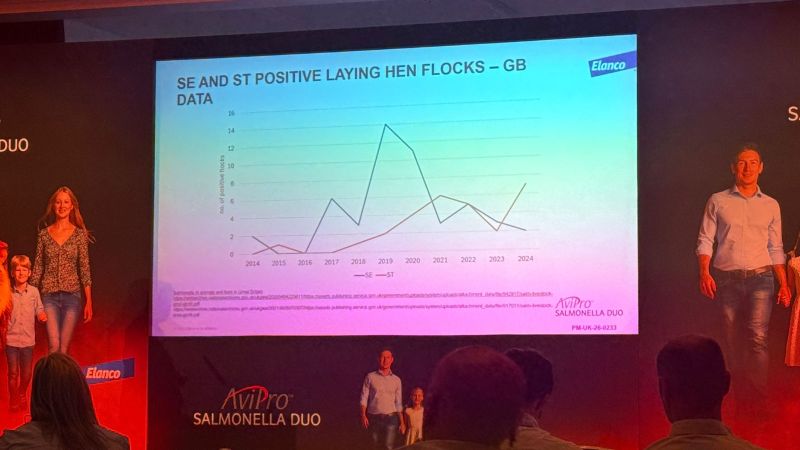
SE and ST positive laying hens - GB data
Mueller-Doblies linked this directly to the industry’s shift towards longer laying cycles — a trend affecting brown and white genetics alike. ISA/Hendrix-Genetics performance data presented at the conference showed eggs per hen at 75 weeks rising from 250 (white) and 239 (brown) in 1970 to 346 (white) and 343 (brown) by 2015, with hens now commonly kept to 90 weeks and beyond as production at 75 weeks has climbed from around 60% to over 80% for white birds and from 55% to 79% for brown. Feed conversion has also improved steadily across the same period, from 3.03 to 2.09 in white birds and 3.46 to 2.19 in brown, while liveability has risen from 90% to 94% in both types – all factors, she said, making it economically attractive to keep a flock in production for longer. "The laying hens have been living longer," she said. "That means immunity against Salmonella is waning."Mueller-Doblies closed with a candid assessment of the limitations in current European surveillance. While EFSA and ECDC produce a detailed joint zoonoses report each year, and member states are required to report the number of flocks tested and found positive for SE, ST and Salmonella spp., she said the system does not currently capture the age of flocks when they turn positive, their housing system, breed, or their position in the breeding pyramid – data she argued would be invaluable in understanding exactly what is driving the European increase. "If I would have an impact, I would definitely try to influence people in Brussels," she said. "We need to collect more and better data."Her summary slide left producers with a clear message: the UK’s achievement is impressive thanks to the Lion Code, and its position relative to the rest of Europe genuinely enviable — but continued vigilance, and better protection of flocks through the full, now-extended, length of the laying cycle, will be essential if that advantage is to hold.