

Rubin outlines US vaccination pathway for HPAI at Warsaw conference
Published on : 21 Apr 2026
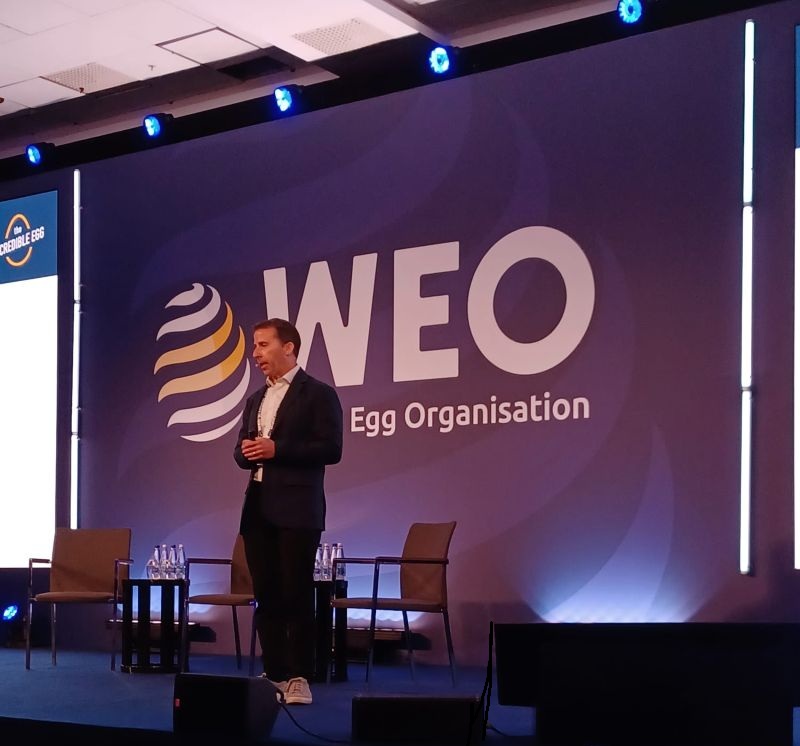 Dr Mickey Rubin, Vice President of Public Affairs at the American Egg Board, was speaking at the World Egg Conference in Warsaw when he set out the U.S. egg industry’s case for HPAI vaccination in layers with a message that was practical rather than rhetorical: the scale of loss in the United States has become too severe to keep treating vaccination as a theoretical discussion. More than 160 million egg laying hens have been lost since the current outbreak began in 2022, with indemnity costs put at around $1.5 billion across the poultry and egg sectors, figures that he made clear still do not reflect the full damage done to farms or the wider strain placed on U.S. egg supply.His argument was not that vaccination offers a clean solution, but that it now needs to be added to the disease control toolbox alongside biosecurity, surveillance and stamping out. Rubin was clear that vaccination would not eliminate HPAI, but said it could significantly reduce incidence and spread. That distinction mattered throughout the presentation. The U.S. proposal is not built around abandoning existing control measures, but around strengthening them with a risk based vaccination programme focused first on the areas and bird types judged most exposed.The plan developed by the industry working group centres on a targeted rather than nationwide rollout. Vaccination would begin in defined states or localised regions, aimed at high risk areas with significant egg production, and would apply to egg laying chickens and potentially turkeys rather than all poultry species. That point is politically important in the U.S., where export concerns from other parts of the poultry sector have remained one of the main obstacles to progress. By keeping the proposal narrow at the outset, the industry is trying to show that vaccination can be introduced in a way that is operationally manageable and less disruptive to existing trade arrangements.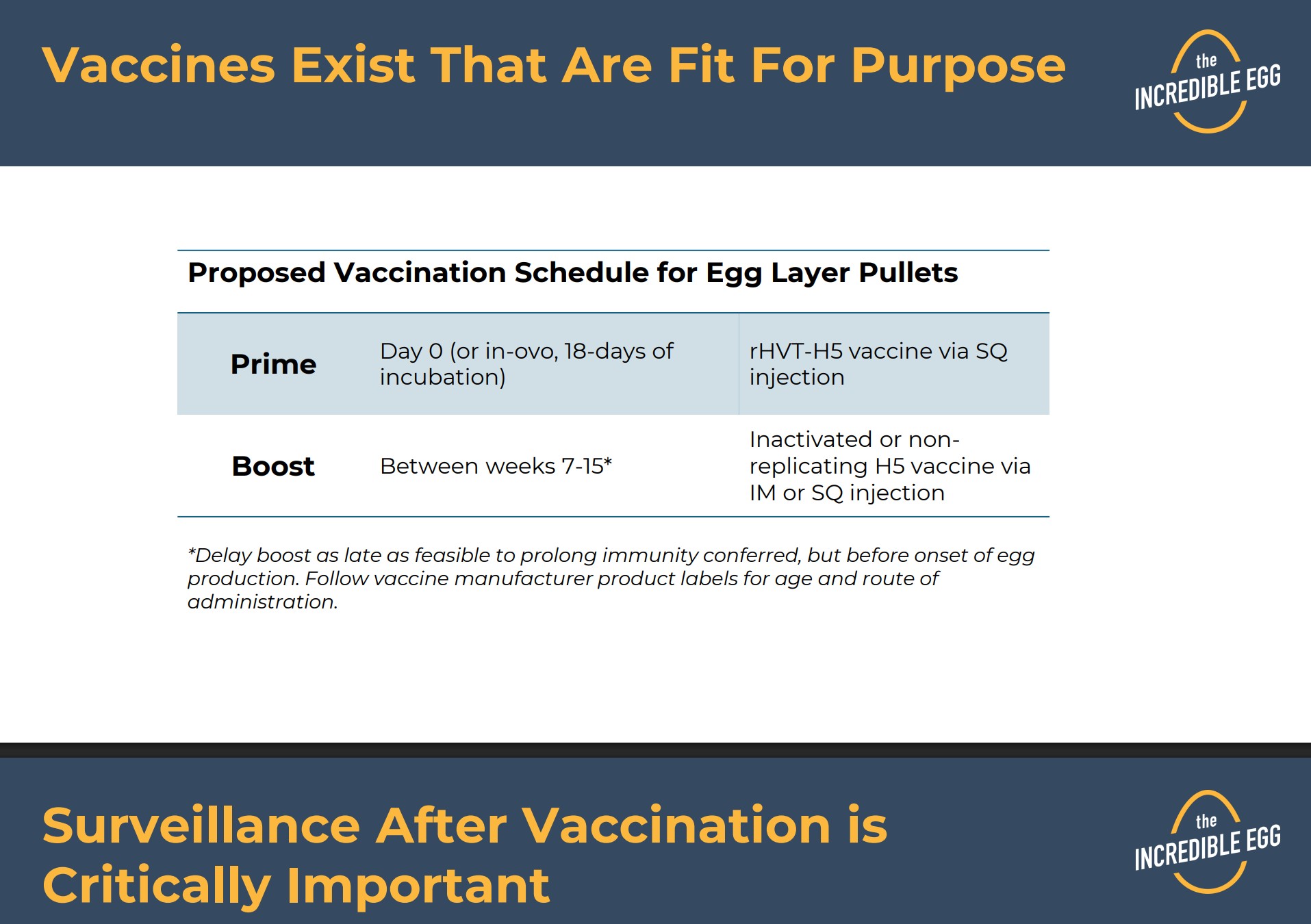
Vaccines exist that are fit for purpose
Rubin also pushed back against the idea that the U.S. is waiting on a future vaccine breakthrough before it can act. The proposal assumes that vaccines already exist which are fit for purpose, but that the regulatory path for commercial use remains the sticking point. The schedule put forward is a two dose approach, with an initial vaccination at day old, or potentially in ovo, followed by a booster between seven and 15 weeks. Built into that is some flexibility for hatcheries and producers, but the broader thinking is straightforward enough: protect birds early, reinforce immunity before the onset of production, and do so using systems that can be integrated into existing management structures.A large part of the credibility of the plan rests on what happens after vaccination, and that is where surveillance becomes central. Rubin’s position was that any vaccination programme will only stand up domestically and internationally if it is paired with robust and disciplined monitoring. The U.S. proposal would use existing USDA APHIS and NPIP infrastructure, with vaccinated flocks subject to regular testing through pooled oropharyngeal swabs every 14 days, using qRT PCR assays. Testing would focus on sick or dead birds, in line with the standards the industry believes trading partners will expect to see. Just as importantly, a vaccinated flock that tests positive would still be depopulated. That answer may disappoint those hoping vaccination could end stamping out, but it reflects the caution built into the U.S. position. The goal is to reduce infection pressure and transmission, not to tolerate virus circulation in vaccinated systems.Trade runs through the whole proposal. Rubin did not avoid that. He acknowledged that acceptance by trading partners remains critical and that the plan has been written with those conversations in mind. The U.S. industry is proposing alignment with international standards, strong surveillance, and the exclusion of certain poultry segments from vaccination in an effort to contain the commercial fallout. It is also proposing that products from vaccinated birds remain in the domestic U.S. market rather than entering export channels, at least in the early stages. That is a significant concession to the realities of international trade politics and underlines how the vaccination debate in the United States is being shaped not just by animal health concerns, but by the need to reassure export customers and avoid wider restrictions on poultry movements and products.The route to implementation is deliberately staged. The industry working group has proposed a phased programme beginning with an immediate pilot, then expansion into multiple high risk states, and only after that wider national rollout. Rubin indicated that moving from first implementation to nationwide coverage could take 12 to 18 months, with the expectation that the early phase would be used to identify practical gaps and make adjustments before broader expansion. In effect, the industry is arguing for proof of concept first, not just proof of efficacy.That is why the pilot programme matters so much. Requested by USDA and then developed in more detail by the working group, the pilot is intended first to demonstrate that a targeted HPAI vaccination programme in layer pullets can be delivered through existing systems for tracking, monitoring and surveillance. Only secondarily is it intended to assess effectiveness against the circulating H5N1 2.3.4.4b virus under U.S. conditions. That ordering is revealing. The immediate challenge in the U.S. is not simply whether vaccination works immunologically, but whether it can be governed, traced and monitored in a way that regulators and markets will accept.The success criteria laid out for the pilot make that plain. The industry wants to show that state, federal and commercial stakeholders can work together, that licensed or conditionally approved H5 vaccines can be administered successfully to chicks and pullets, that immune responses can be measured through serological monitoring, that vaccinated birds and their products can be traced from hatch to final disposal, and that surveillance in vaccinated flocks is both feasible and sustainable. This is a blueprint designed as much for policymakers and trading partners as it is for producers.What emerged most clearly from Rubin’s remarks, though, was the gap between technical preparation and political movement. He said USDA has developed its own version of a vaccination plan and that it is highly compatible with the industry proposal, which suggests there is more consensus within the system than there was a year ago. Even so, there is still no approval to proceed. The pilot remains proposed rather than active, and the wider programme remains blocked.That leaves the U.S. egg sector in a familiar position: convinced it needs vaccination as part of its HPAI response, equipped with a structured proposal for how to deliver it, but still unable to move from design to implementation.