
Record margins, mounting risk
Published on : 26 Aug 2026
Since the last producer price round up, the tone in the market has moved from buoyant optimism to a sense of mild foreboding.
It's true that there is more politics in an egg than yolk. When the market's up, you're talking the market up, and with it, more production; when it's down, you get the opposite. The facts are, when it comes to the price survey we leave the politics to others and present the facts. However favourable or uncomfortable.The more things change, the more they stay the same. Since the last producer price round up, the tone in the market has moved from buoyant optimism to a sense of mild foreboding. Record margins reported in March were helped by the tailwind of softening feed prices and still-escalating rewards for your dozen eggs. Now deep into August, a combination of the ongoing conflict in Iran and extreme weather has imparted their unwelcome influence on feed price. Meanwhile, the value of eggs appears at something of a precipice. The fallout from the salmonella incidents in imported egg in the UK has yet to play out in retail. It is too early to say how this will affect retail. Informal reports and wholesale market indicators point to a seasonal surplus not witnessed for 5 years or more, with several UK egg breakers declining the opportunity to buy raw material at less than half the cost paid by the original purchaser, the packer. And yet, according to this survey, those losses at the packer are not being passed down the line to the farmer. Good news, then, for producers. But unless the market is working for everyone, it has a tendency to bite back.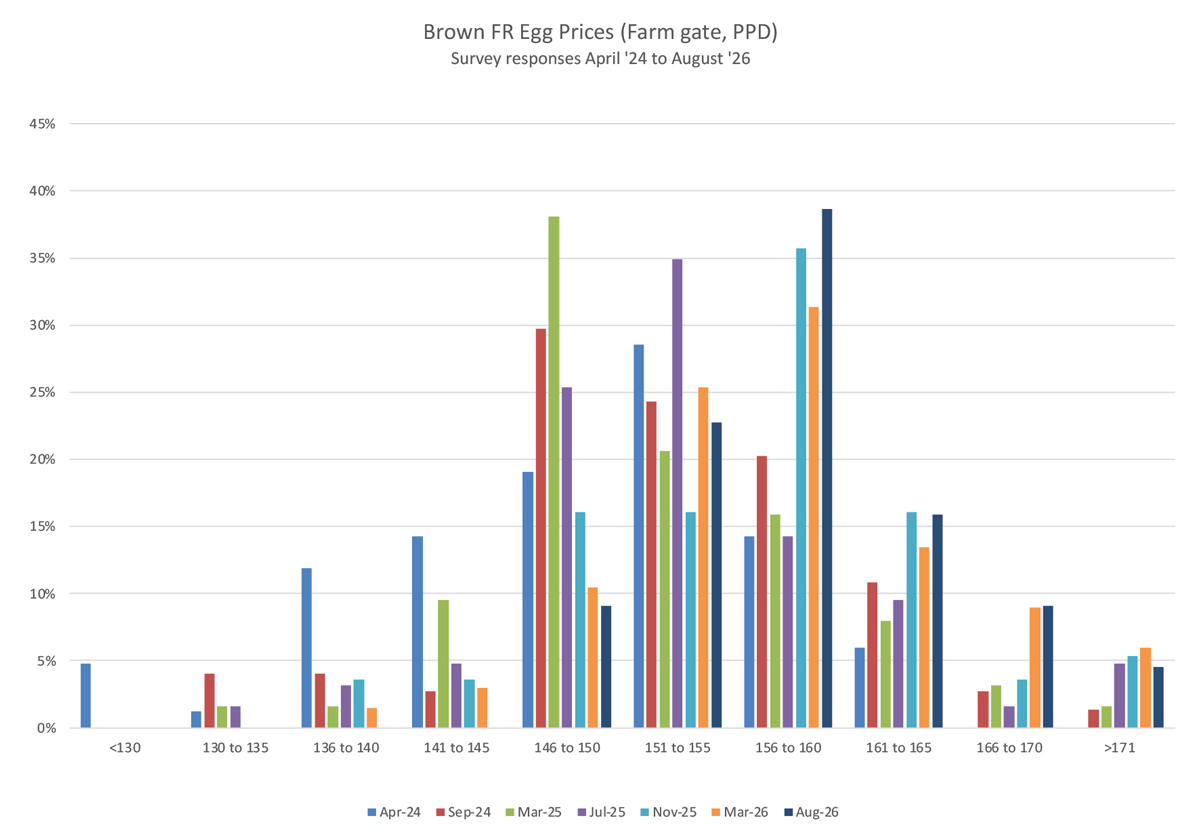
Brown Free Range Egg Prices - Farm Gate PPD
After an earlier report than usual in March, now 4 months have elapsed since BFREPA last dipped the tank. The headline findings are these. For brown free range eggs, the mean average reported price is two pennies higher at 159.3 pence per dozen. The median price was also 159ppd. The highest paid farm responding to the survey quoted a flat, all-egg price of 180ppd. The lowest return equated to 146ppd when extrapolated over the usual ADAS-provided grade profile. Interestingly, the two farms named the same customer.It's worth setting the survey's brown egg figures against the ADAS egg price for this month. ADAS calculates an average of 158.4ppd, up 0.2p since last month, sitting just under the survey's own mean of 159.3ppd, a gap of less than a penny. It's worth noting, though, that the ADAS figure is an average across all free range units, irrespective of scale, whereas higher prices may be paid to some of the newer units, reflecting the higher production costs ADAS notes in section 5.2 of its costing. What is very telling is that it is rare for the survey price to vary by more than a penny against the ADAS price and so it is, the only time BFREPA can recall that happening was in the previous survey.
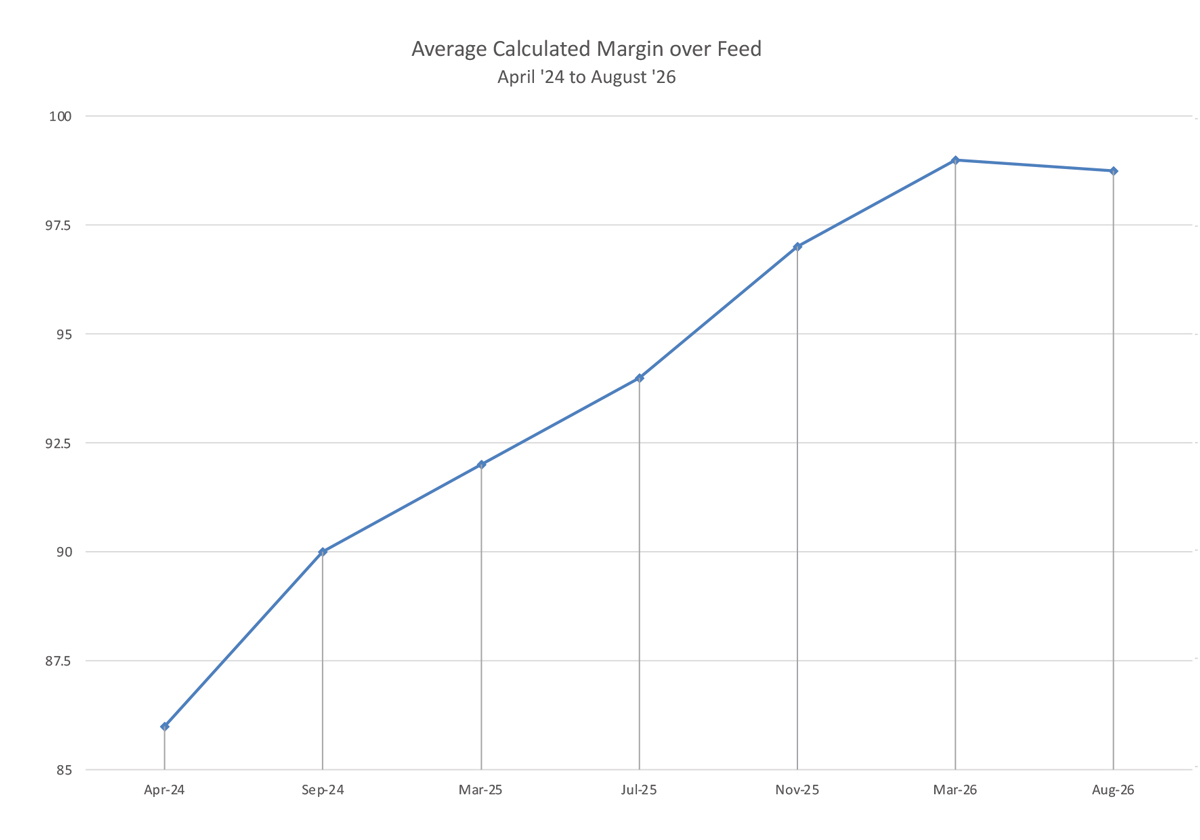
Average Calculated Margin Over Feed
Feed price has risen by over £7/t to £302.50. The net result is a slight scratch on calculated gross margins, or margin over feed, down just a quarter of a penny to 98.7ppd.It's worth setting the survey's feed price against the ADAS Cost of Production figure. The average compound feed price ADAS reports stands at £316 per tonne, up £5 on last month, against the £302.50 per tonne reported by BFREPA's own members, a gap of £13.50. Some of that will simply be timing, with producers sitting at different stages of their feed contracts. But there is also a real difference in buying power at play. Some packers, with more tonnage to place, are able to negotiate feed deals for their farms that a smaller or standalone producer cannot get near. It's also worth noting that ADAS ask feed mills to quote against a specific requirement, the detail of which can be found in the ADAS free range annotations within the members area.Looking back over BFREPA's full run of survey data, from April 2024 through to this August, the shift is unmistakable. In April 2024, the largest single group of respondents sat in the 151 to 155ppd band, with a meaningful cluster still below 140ppd. By August 2026, that has shifted decisively into 156 to 160ppd, with the tail beyond 161ppd now larger than it has ever been. What is notable, though, is how little that picture has changed since March this year, when the same band was already dominant. The steepest climb happened earlier, and the market this summer looks to have paused rather than continued to push on.
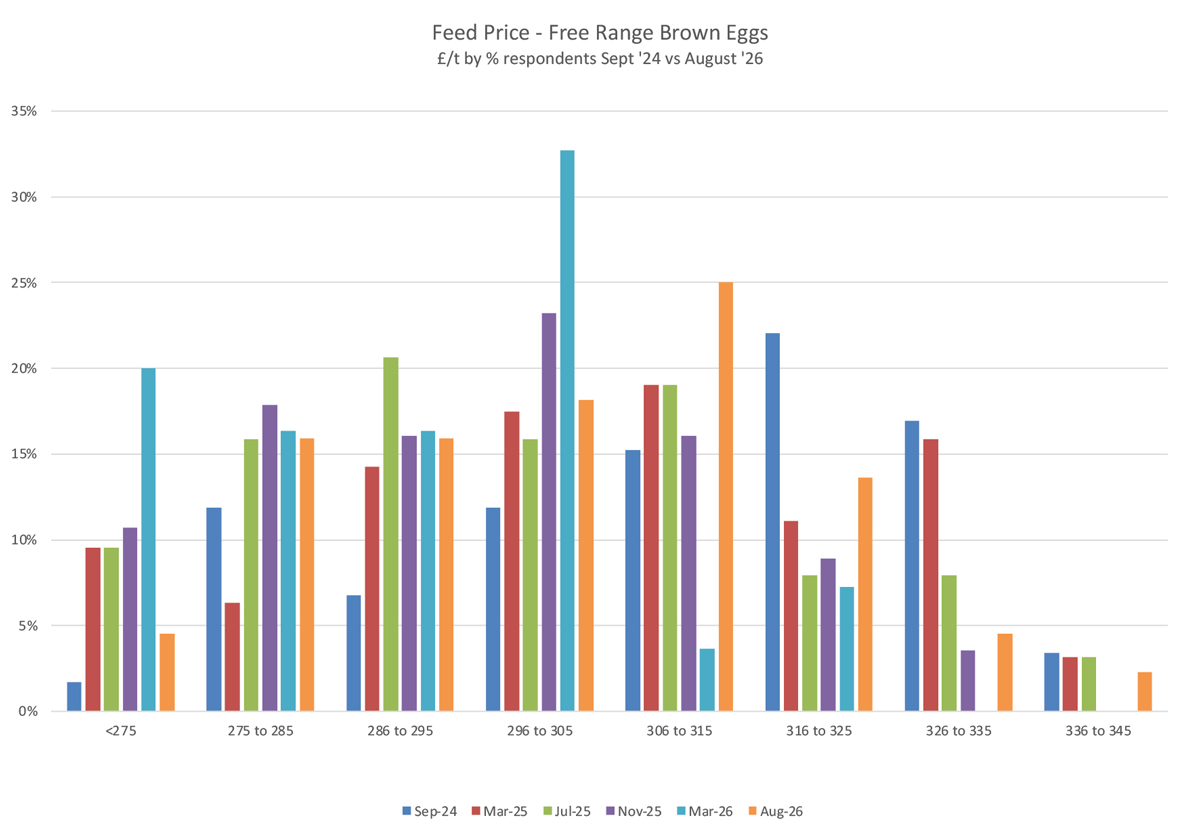
Feed Price - Free Range Brown Eggs
The margin over feed tells a similar story. From an average of 86ppd in April 2024, it climbed steadily and almost without a wobble to a peak of 99ppd in March this year, before easing back very slightly to the 98.7ppd currently reported. Two and a half years of continuous improvement in that margin appears, for the first time in this data, to have levelled off.Feed price itself explains a good part of both. Respondents were most commonly paying in the 316 to 325ppd range back in September 2024. That fell steadily through 2025 and bottomed out around March 2026, when the largest group of respondents were paying under 275ppd, the cheapest feed reported anywhere in the survey's history. Since then the picture has reversed sharply, with the August 2026 figures already back up into the 306 to 325ppd range. That reversal, arriving just as egg price growth has stalled, is exactly the pincer movement squeezing margin over feed for the first time since the survey began.As white eggs have established as regular a position on the supermarket shelf as the processors' boiling plant, so is their inclusion in the survey. More farms than ever reported white egg prices, with the mean average three quarters of a penny higher than March at 157.0ppd. The median price shared was 155.6ppd. The anticipation of the ADAS white bird costing, now coming to a conclusion and expected to be published in the Ranger, is accompanied by nervousness that the independent overview will point to a much greater disparity in production costs than is reflected in the price currently paid to the white egg producer. While this and previous member surveys have suggested white egg farms receive a minor discount of 2 to 3ppd on their price, it's the trusted gold-standard benchmark that ADAS sets that will give a better understanding of any differences. The question is how will the ultimate publication of a cost benchmark affect the fine balance currently in the market?With repeated severe heatwaves, retail demand has been soft over a prolonged summer. With many left in a surplus position, packers continue to pay farmers their 160ppd for ungraded eggs. On top of the egg price, the packer is paying to collect, store, possibly grade, then haul again to a processor to receive 80ppd for the trouble. Such losses mount very quickly and, in a normal year, these costs could not and would not be tolerated. But this is no ordinary year. With no downward price movement in the market this decade, before Covid, there is no 'noise' behind which to screen the bad news. Such is the scrutiny of the whole chain on farm gate price that the middle-men are opting for the status quo as the safe place. If in doubt, do nowt.Contractual obligationsCould a packer unilaterally adjust a producer's egg price? Certainly, this is the behaviour of old, but things have changed, at least for some farmers. There is far wider variation in the terms and conditions of egg supply agreements than just a handful of years ago. As a consequence of both a defensive move to shore up supply and the push to recruit farms from competitors, packers have been forced to make amendments to their contracts. All-egg prices. Fixed prices for a flock or multiple flocks. ADAS-linked, feed linked, feed and pullet integrated. There are many new mechanisms in place.And there are more people watching than ever, including the Agricultural Supply Chain Adjudicator. Created under the Agriculture Act 2020 to tackle the imbalance of power in buyer and seller negotiations, the adjudicator presides over established regulation for milk and pork industries. The Government launched their Fairness in the Supply Chain review in late 2023 with a third iteration of proposed regulation presented to BFREPA in February this year. As yet, farmers haven't had need of such support since their inception.According to this edition of the member price survey, exactly 50% of farms are on a full Cost of Production or feed tracking price adjustment mechanism. Taken at face value, then, only half of egg prices are accessible for anyone wanting to reflect supply and demand. In reality, BFREPA has seen that farms reporting to have the security of cost-linked contracts have enjoyed the same increases in egg price over recent times as those without such links.Since the prices started to rise in late 2022, the UK flock has added 7 million birds of total capacity, and because of the reversal of destocked housing in 2022 itself, there are now 8 million more birds in production. That's an increase in output of nearly 23% in under 4 years. In the last year alone, the free range flock grew by 7.4%, adding 2.5 million hens. According to housing and equipment manufacturers, the pipeline for the next couple of years seems equally busy. A cage ban is anticipated at some stage on or after 2032. At the current rate, the 5 million hens remaining housed in cages will be usurped before 2029.Back to the (near) future, it appears that there is a collective crossing of fingers. Producers and packers are wishing for a sharp return from summer holidays, and a cold snap to encourage shoppers back to their baking ovens and frying pans. There is also a quieter hope that the imported salmonella scare has not dented consumption as much as some in the trade fear. Maybe it pushes consumers to British and increases consumption. But that raises an uncomfortable question. How many more years can this industry expect something else to come along and bail it out of oversupply? The cage ban, forcing conversion whether packers and retailers like it or not, may be the last remaining get-out-of-jail card left.