

Poultry Sector Urged to Move from Firefighting to Future Planning
Published on : 25 Feb 2026
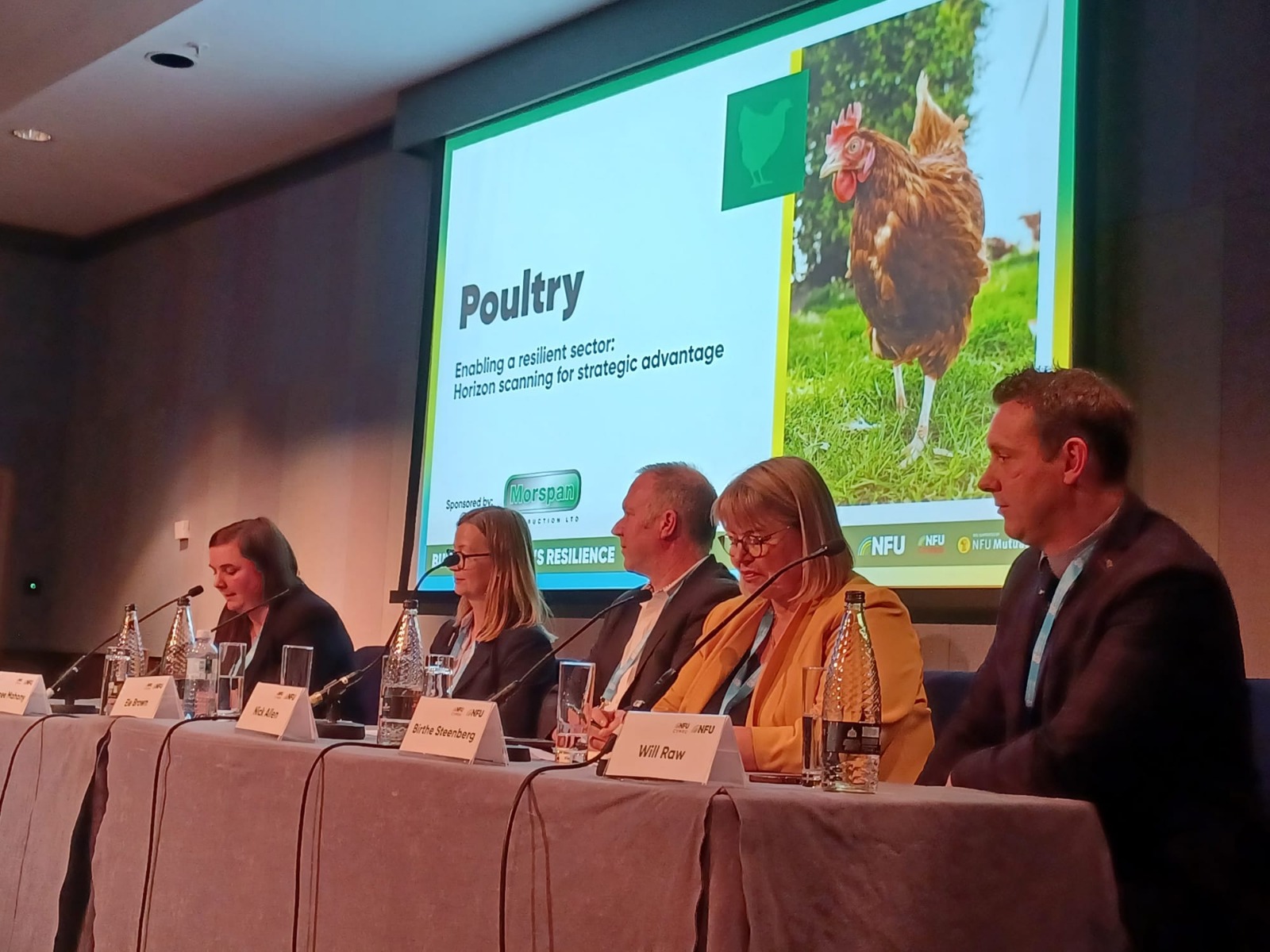
The NFU Poultry breakout session drew a packed audience to Hall 10
Speakers at the NFU Poultry breakout session warned that while the sector remains resilient and commercially strong, constant firefighting over disease, policy and trade risks preventing long term strategic progress.The NFU Poultry breakout session drew a packed audience to Hall 10, where resilience, realism and frustration defined a lively discussion on the future of the sector.Titled Enabling a resilient sector – horizon scanning for strategic advantage, the session was chaired by NFU Chief Poultry Adviser Aimee Mahony and brought together a panel with experience spanning farm, policy and international trade. Speaking were Nick Allen, CEO of the British Egg Industry Council, Ele Brown, UK Deputy Chief Veterinary Officer at APHA, Will Raw, NFU National Poultry Board Chair, and Birthe Steenberg, Secretary General of AVEC, the European Association of Poultry Processors and Poultry Trade.The discussion opened with a clear message: poultry is fundamentally resilient, producing affordable, nutritious and sustainable protein, but it is operating in a near constant state of firefighting. From avian influenza and input costs to consultations and policy pressure, speakers acknowledged that the industry rarely has the breathing space to step back and plan strategically.That theme carried strongly into the question and answer session, where producers challenged the panel on whether the sector is doing enough to defend its position and shape its own narrative.One of the sharpest exchanges focused on the Lion scheme and marketing investment. A producer questioned whether enough was being done to strengthen the Lion’s presence in the processing sector, pointing to the continued use of imported egg in some areas of food manufacturing. He argued that the Lion message needs to be pushed harder beyond retail shelves and into processing channels where visibility is lower but volumes are significant.The marketing budget itself also came under scrutiny. With reference to an annual spend in the region of £1.5 million, it was suggested that this figure represents a very small proportion of total farmgate returns and would be considered modest for most branded products. If eggs were treated like a mainstream consumer brand, the argument ran, the industry would be investing considerably more in promotion.Nick Allen defended the long term approach behind the Lion campaign, emphasising that the objective is sustained brand reinforcement rather than short term sales spikes. Consumer recognition of the Lion mark has remained consistently high for more than a decade, he said, and that stability reflects steady investment over time. He also highlighted that this year’s campaign is more joined up, aligning trade and retail messaging to improve overall impact. On processing, he acknowledged the concern and accepted that continued focus is needed to ensure Lion egg remains competitive and visible across all channels.Another powerful intervention came from James Baxter, chairman of the British Free Range Egg Producers Association. Referring to earlier comments about NGO influence, he spoke candidly about what he described as a continual battle with the RSPCA and RSPCA Assured. In his view, engagement can be difficult and positions are sometimes advanced without sufficient evidence.Baxter argued that the sector should not be operating defensively. Consumers already trust the product and the standards behind it, he suggested, and the industry should be setting the agenda rather than responding to it. He revealed that he and colleagues were due to meet RSPCA chief executives later in the week and, in a pointed moment, invited Birthe Steenberg to attend in his place, saying they needed to hear her message directly.Steenberg’s response was pragmatic; she encouraged the sector to seek areas of agreement with NGOs, particularly around import standards, and to engage consistently rather than withdraw. Transparency and proactive communication were critical, she said, arguing that producers must show the public what they do well and not allow others to define the narrative.Planning, public procurement and avian influenza regulation were also raised during the session. Producers highlighted the difficulty of securing permits to build new sheds or expand capacity, describing planning as one of the most significant barriers to growth. Will Raw confirmed that the issue is repeatedly raised with ministers and that there are substantial sums of investment waiting for the confidence that a workable planning environment would provide.On avian influenza, Ele Brown acknowledged that disease control frameworks may need to evolve as the pattern of outbreaks changes. She stressed the importance of surveillance and biosecurity, while recognising that infectious disease management is as much about human behaviour as biology.Throughout the session, a consistent message emerged. The poultry sector is performing strongly in the marketplace and has high standards that compare favourably internationally. However, resilience is not just about surviving shocks. It also depends on securing fair trade conditions, enabling investment through practical planning policy, defending domestic standards against lower welfare imports and telling the sector’s story with confidence.If the title promised horizon scanning for strategic advantage, the discussion made clear that the horizon is crowded. The opportunity is there, but only if the industry moves beyond firefighting and takes control of its direction of travel.