

Feed is 70 per cent of egg costs and diets are being set the wrong way round, says Spanish nutritionist
Published on : 28 Sep 2026
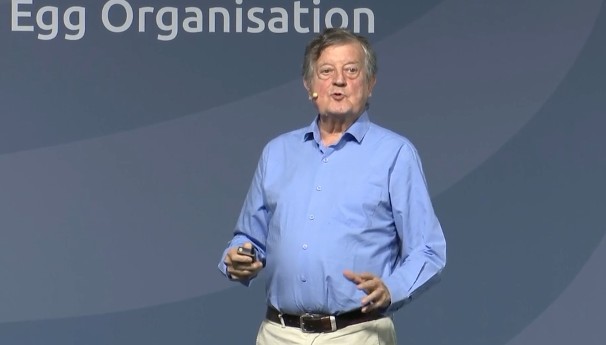
Professor Gonzalo González Mateos of the Universidad Politécnica de Madrid
Laying hen diets need to be rebuilt around the genetics, housing and management of the modern bird rather than carried over unchanged, Professor Gonzalo González Mateos of the Universidad Politécnica de Madrid told the World Egg Organisation conference in Singapore.Speaking on the morning of Thursday 10 September in a session titled What's Next in Layer Nutrition, Professor Mateos said feed accounts for 70 per cent of the cost of producing an egg, and that is where most of the important changes for the future of egg production begin.Disease, scale and the consumerWorldwide egg production is expected to rise, but disease control remains a real problem, and he pointed out that producers in Europe are currently making a lot of money from eggs because of disease, which is the opposite of what anyone would expect.Integration is moving fast. In Spain, which has around 45 to 50 million hens, one Brazilian company went from nothing to become the second biggest producer in five years, changing the situation completely in three or four years. Economies of scale are behind it, because more hens means fewer people per hen and theoretically cheaper eggs, while legislation that varies between countries ends up being used as a market barrier.Meeting customer demands under cost control is another issue, because although the consumer is king, the industry does not always know what the consumer wants. Niche products, such as the omega-3 eggs of a few years ago, were one route he suggested for increasing consumption.Change the diet when the bird changesThe birds have changed and nutrition has to change with them, Professor Mateos argued. His advice to nutritionists is to look first at what the geneticists have done, then at how vets and managers are handling the flock, and only then formulate the diet, whereas in many places he sees the reverse, with new birds, new buildings or new environmental control arriving and the existing feed programme left as it was.Geneticists are pushing for longer laying cycles, and at a recent meeting in Mexico the discussion had already moved from 100-week cycles to 120 weeks, so producers should be ready for cycles to go longer still. The target is sellable eggs rather than peak production, with the focus on bodyweight uniformity at five weeks and slender pullets at 12 weeks.He has never seen a country where producers moved from environmentally controlled buildings back to open houses, and investment should be planned on that basis. Stress is the key issue in hens and not a philosophical concept, he told delegates, since a stressed hen, like a stressed worker, keeps going but does not do the job properly, and for a bird the most important stress is digestive. "They are not thinking with the head, they are thinking with the stomach," he said.Welfare, food safety and deforestationEurope tends to set the direction on consumer demands that other countries eventually follow. According to the European Commission figures he presented, the EU had 401.1 million hens in 2025, with 35.7 per cent in cages, 41.3 per cent in barns, 16.5 per cent free range and 6.6 per cent organic. That puts about 65 per cent of EU hens out of cages, compared with only around 30 per cent in Spain, which he explained tends to let other member states legislate first and learn from them, because a good soldier never volunteers.Debates over bans on cages, moulting and beak trimming will continue, and none of them lower costs. With antibiotics no longer allowed for preventive use in Europe, problems such as Salmonella have to be solved through nutrition or the environment, while aflatoxins and heavy metals are narrowing the range of ingredients available.Deforestation is now the most important sustainability issue, in his view, because new European legislation bars soybean meal from deforested land and that is very hard to control. "The wolf is coming, but still not arrive to the farms," he said. He expects future figures to show cages continuing to fall and free range rising, with organic growing only slowly because it is very expensive.Cutting cost elsewhereHigher welfare spending raises the cost of production, so savings have to come from other areas. Professor Mateos reduced the circular economy to one sentence: "Do not throw away anything. That's what your grandma used to do." Precision feeding he summed up as reducing safety margins, matching nutrient supply to what the bird needs and controlling feed wastage.New additives are here to stay, and products once thought dangerous, such as tannins, have been shown to improve egg production, although what matters is the dose, not the name of the product.Feed mill technology still needs to improve, and NIRS is a useful tool but not a perfect one, since it cannot be relied on for calcium and phosphorus when it only measures the organic fraction. Whenever soybean meal prices rise he is asked for a new raw material. "I don't know of any new raw material. I know material that you are not using, but not new," he said. There is more money in using existing ingredients better, he argued, for example by separating soybean meal by origin, because meal grown close to the equator is very different from meal grown far from it.A 160-year-old analysis systemProfessor Mateos was critical of the Weende proximate analysis, agreed 160 years ago by chemists before nutritionists existed and still used everywhere. Crude protein is calculated as nitrogen multiplied by 6.25, a factor based on milk, meat and eggs, yet none of the ingredients fed to laying hens has that factor and soybean meal is closer to 5.1. Buying on crude protein therefore means buying on nitrogen, which does not disappear when soybean meal is overcooked, unlike lysine and methionine. The gap between summed amino acids and crude protein is around 8 per cent in a good soybean meal and close to 20 per cent in an overheated one.Laboratory results also depend on the method used. Soybean meal shows 6 per cent starch when measured polarimetrically and none when measured enzymatically, enough to change its predicted energy value by 400 kcal, and nitrogen-free extract is not an extract at all but the label given to everything the original chemists could not analyse.Beaks, gizzard and liverBeaks are the hands of the bird, and he has seen many mistakes with crumbs too big for pullets in their first three or four weeks, although very finely ground feed is eaten less and bypasses the gizzard. "The gizzard is the boss, the CEO of the company," he said. When it is working properly its pH is low and the enzymes work better. The liver carries out more than 100 functions and makes all the fat in a laying hen, so a bird producing an egg a day puts it under heavy strain.Calcium, phosphorus and phytase make up what he calls the Bermuda Triangle of layer nutrition, because producers often get their interaction wrong. Excess calcium in young pullets reduces feed intake and phosphorus digestibility, raises gizzard pH and encourages Clostridium, making it the most expensive nutrient in poultry diets. Coarse limestone supplies dietary calcium overnight and makes the gizzard work harder, and shell quality is best when calcium comes from the feed rather than from medullary bone.Pullets and hensEverything is defined in the first five weeks of life, and he prefers crumbs in that phase because they improve uniformity and intake. Between five and 17 weeks the aim is slender pullets with long, wide bones, developed muscle and room for medullary bone rather than small, round birds, and the move from pullet to layer between 17 and 25 weeks needs high levels of all nutrients.Hens eat to meet their energy requirements rather than a set number of grams, and when they fail to do so the producer has done something wrong, often because the digestive tract has not developed. The fix is insoluble fibre, which is not costly and benefits hens more the more of it is used. He concluded that sound nutrition cannot make up for poor management but helps reduce cost, that changes should be based on sound data, and that eggs from caged hens will decline.