

Dust contamination on free range eggs
Published on : 16 Mar 2026
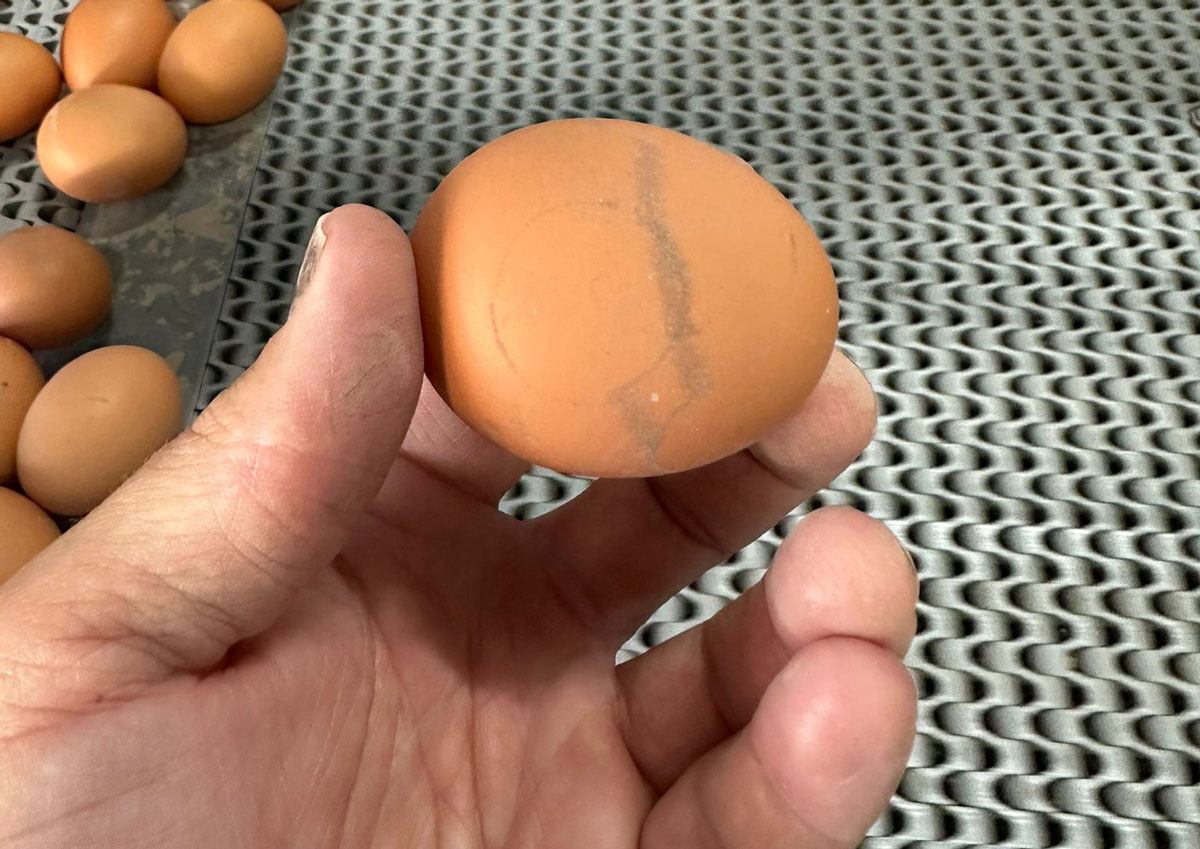
Moisture on the freshly laid egg allowed the dust to adhere firmly to the shell
Dust contamination on eggs is something most free range producers will have encountered at some point. However, over the past winter a number of units have reported a noticeable increase in dusty eggs, raising questions about why the issue appears to have become more common and what practical steps can be taken to prevent it.Across the sector the issue appears to be linked to a combination of housing orders, very dry litter conditions and the way modern sheds operate. Suffolk producer Dan Brown, who runs 64,000 free range layers across two 32,000 bird houses, experienced the problem first hand last autumn and his experience shows how quickly dusty eggs can escalate from a minor nuisance into a serious grading issue.The first indication that something was wrong came through grading returns. Seconds began to rise sharply, increasing from a typical level of around 0.3% to as high as eight or nine percent. While the shed itself appeared to be operating normally, the egg belts told a different story.Fine dust was settling overnight onto the belts and when eggs were laid and rolled onto the belt surface, the moisture on the freshly laid egg allowed the dust to adhere firmly to the shell. As the egg rolls across the belt while the cuticle is still damp, the dust effectively sticks to the shell surface. The result was a visible band of contamination around the egg, often appearing as a dusty line around the equator of the shell. Once the dust had adhered to the cuticle it was extremely difficult to remove.Several factors combined to create the problem. One of the most significant was the extended housing period over the winter. When birds are confined indoors, every dust bath takes place inside the shed rather than partly on the range. At the same time litter tends to become extremely dry and friable, which is exactly what producers aim for from a welfare and management perspective. However the same conditions that indicate good litter quality can also increase airborne dust levels inside the building.During a housing order every bird is dust bathing inside the shed and over time that increases the amount of fine particulate matter circulating in the air. Eventually that dust settles onto equipment including egg belts, transfer points and other surfaces.Shed design can also influence how much of an issue this becomes. On Dan Brown’s unit two different housing systems operate side by side. One is a 32,000 bird multi tier shed using equal pressure ventilation with multiple turrets pushing and extracting air through the building. The other is an older naturally ventilated flat deck shed which was later converted to a multi tier system.In the converted building airflow beneath the tier structure was limited and this created a still air zone underneath the system where dust accumulated. Looking down the shed it was possible to see dust hanging in the air in this area. Without sufficient airflow beneath the system, dust settled readily onto egg belts and surrounding equipment.External conditions can add to the problem as well. On lighter soils, particularly during dry periods, birds can quickly remove vegetation from sections of the range and expose loose soil. When this happens dust generated outside can be carried back into the shed on birds and equipment. In Dan Brown’s case a prolonged dry spell meant the birds had removed much of the grass in places and were scratching through light, dusty soil which was easily carried indoors. Combined with very dry litter inside the building and limited airflow beneath the system, this created what he described as a perfect storm for dust contamination.Management practices can also influence how quickly the problem develops. One example is the timing of egg belt operation in new flocks. If pullets are housed but belts are not run for several weeks, dust can accumulate on the belt surface. When the first eggs arrive they immediately roll across a belt already coated with dust. Some experienced producers avoid this by running belts from around week sixteen or seventeen, even before eggs are expected. This helps remove dust buildup and also familiarises birds with the sound of the belts before production begins.Across the industry producers are using a range of practical approaches to reduce the impact of dust. Some blow down egg belts before they are run for the first time, sometimes using a simple leaf blower to remove accumulated dust. Others run belts during the night so that any dust which has settled is removed before the morning laying period begins. In some cases small fans or directed airflow have been used to blow dust away from belts as they run. Transfer points where belts change direction can also collect dust and feathers, so regular cleaning of these areas can make a difference. Most egg collection systems also have brushes fitted to the belt as standard and it is worth checking that these are positioned correctly and doing their job effectively.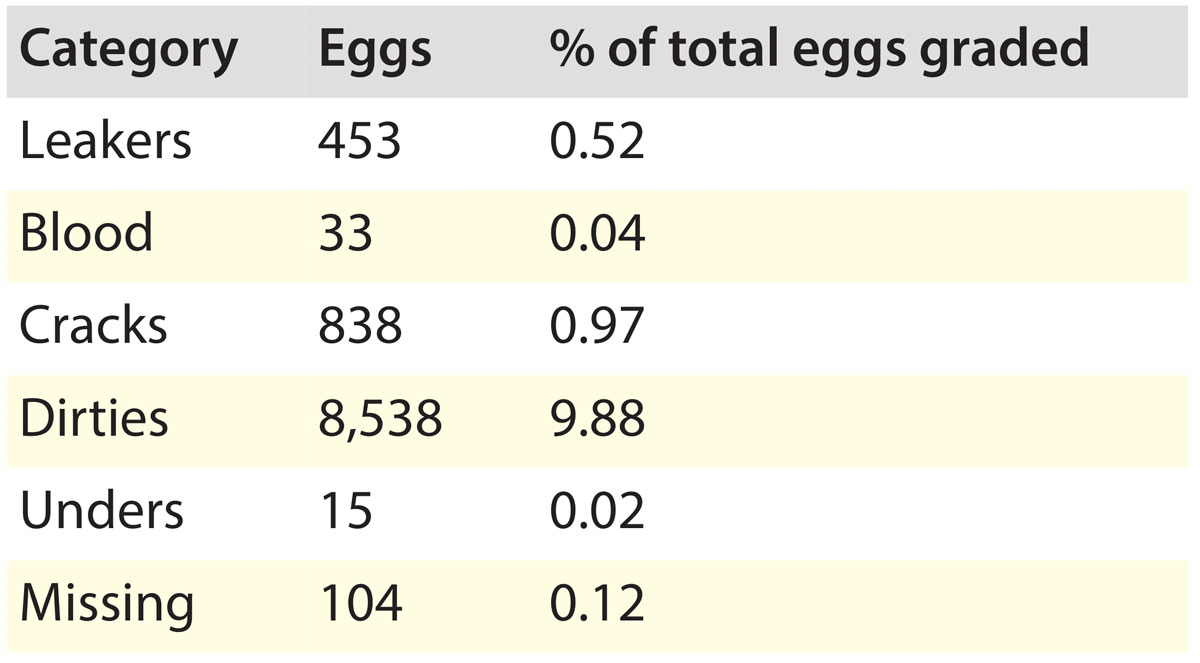
Grading breakdown before the misting system
On Dan Brown’s unit the solution that ultimately resolved the issue was the installation of a high pressure misting system. The system runs for one minute every half hour and produces a very fine mist that simply lays the dust in the shed air. Importantly it does not wet the litter or create damp conditions in the house. Instead it binds the airborne dust particles and causes them to fall out of suspension so they cannot settle on the egg belts.
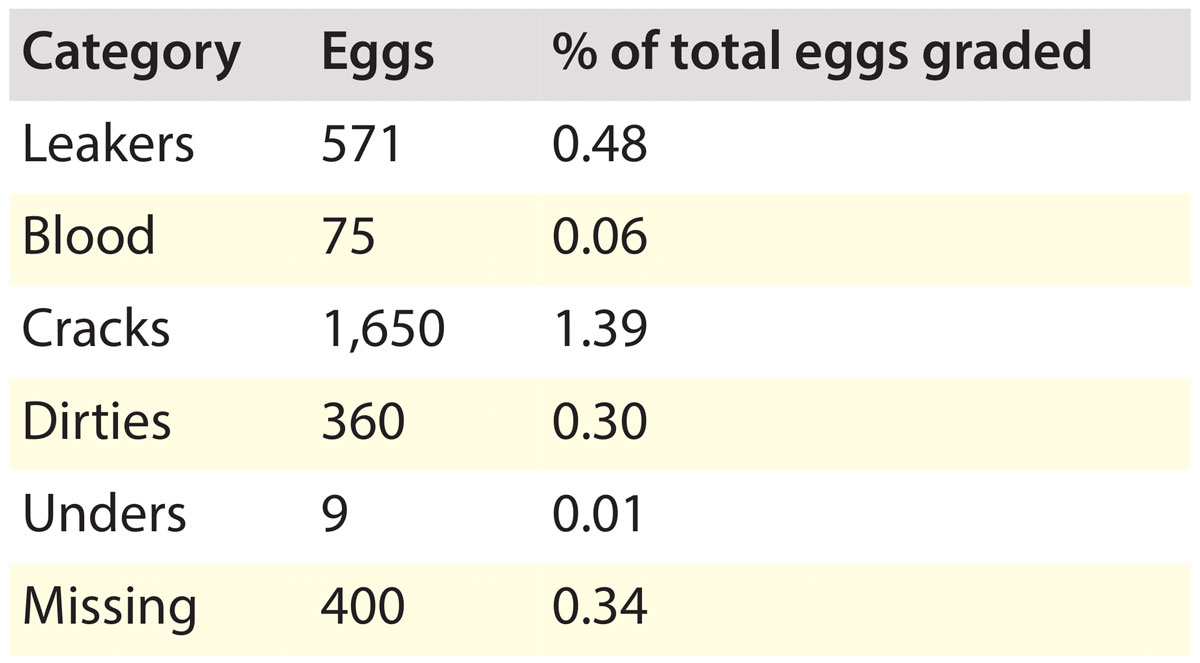
Grading breakdown after the misting system
There was some concern initially that birds might react badly to the system when it first started operating. In practice the flock only reacted for the first two or three cycles. To help with the introduction, the portal lights were switched off when the system was first activated so the birds were less aware of the mist. After those first few activations the flock quickly became accustomed to it and the system now runs without disturbing them.Before the misting system was installed the grading results clearly showed the scale of the problem, with dirties making up a large proportion of seconds.After the misting system was introduced the improvement was immediate. Dirties dropped back to around 0.3%, returning the grading profile to normal levels. It is important to note that this refers specifically to dust contamination rather than total seconds, as other categories such as cracks, blood and leakers continue to occur as part of normal grading. Since installing the system the level of dirties now typically ranges between 0.3% and 0.7%, which is considered well within acceptable levels for normal production.Although dusty eggs are often seen primarily as a quality issue, dust in poultry houses can contain a mixture of materials including dried manure, litter particles, feed and soil. These materials can carry bacteria and once dust adheres to the shell surface it can deposit those microbes onto the egg. For that reason cleanliness of egg belts, nest boxes, conveyors and packing equipment remains an important part of maintaining egg hygiene.One important lesson from the experience is the value of monitoring grading returns closely. Dust problems can develop gradually and may only become obvious once seconds percentages begin to increase. If grading reports are not checked regularly the trend can easily be missed until packers raise concerns.What is clear is that dusty eggs rarely have a single cause. Instead they tend to arise from a combination of factors including housing orders, very dry litter, heavy indoor dust bathing, ventilation patterns within the shed, dust accumulation on belts and external soil conditions on the range. Every unit operates under slightly different circumstances and the balance of these factors will vary from farm to farm.The encouraging point is that practical solutions do exist. In some cases improved belt management may be enough. In others airflow adjustments or dust suppression systems may be required. Misting systems themselves can be expensive installations, which means producers often have to be inventive in finding practical ways to control dust in their own buildings.What matters most is recognising the problem early and taking action before grading losses begin to escalate. As Dan Brown’s experience demonstrates, once the underlying cause is identified it is usually possible to bring the situation back under control relatively quickly.Gary and Dan met with the head of the EMI on Friday, who reported that EMIs are seeing an increase in issues across the country and had reached out to BFREPA to better understand the situation.At present, the lack of a specific category for “dusty” eggs, which we have asked for, makes it difficult to accurately assess what impact this is having on the level of seconds being recorded.Gary advised that in the meantime producers should maintain good dialogue with their packers to better understand their own levels, as this can potentially have a significant impact, particularly at the start of lay.