
Cheapest layer diet is rarely the most profitable, WEO conference told
Published on : 24 Sep 2026
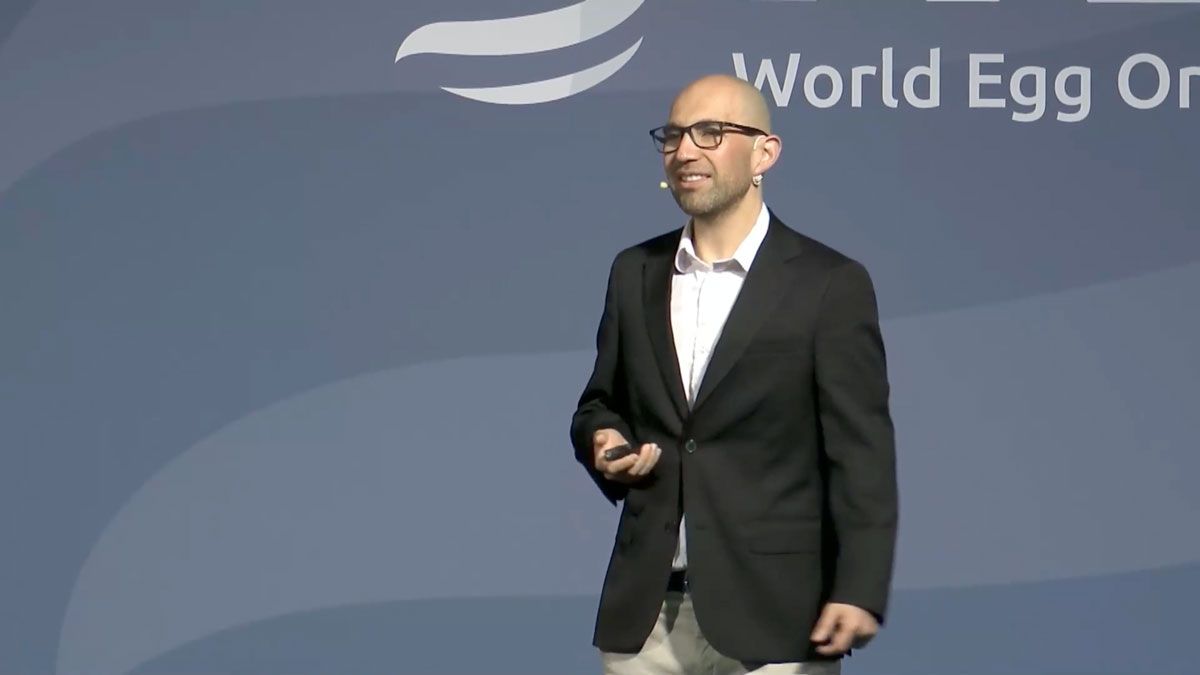 Lohmann nutritionist Dr Nelson Aguilar Vera told the World Egg Organisation's Singapore conference that producers should judge feed on cost per saleable egg, and warned that underfeeding in long cycles often goes unnoticed until the end of lay.Layer diets formulated for the best feed conversion or the lowest price per kilo can cost more to feed than a lower-energy ration, Dr Nelson Aguilar Vera, global technical manager for nutrition at Lohmann Breeders, told the World Egg Organisation (WEO) conference in Singapore on 10 September.Dr Aguilar Vera, who works with producers across North and Latin America, told delegates that before anyone talked about nutrients the business had to ask where it was losing money, whether that was feed cost, poor performance, shell quality or eggs that were not the size the market wanted. He described it as a manager's question, because the answer set the goal for the whole technical team, the vet and the farm manager included.Feed made up 68 per cent of the cost of producing an egg in his figures, with pullet replacement at 21 per cent and labour at 8 per cent. But he was clear that nutrition never replaces good management, and that every time producers tried to compensate for something through the diet their costs went up a lot, when it was usually cheaper to fix the problem through health or management. When birds are healthy "everything is easier, and I would say that everything is cheaper also," he said.How much should a hen eat?The question he is asked most often on farm is how much birds should eat, and his answer was to ask how much the producer wanted them to eat. Because intake follows the energy density of the diet, a nutritionist can cut intake and improve feed conversion simply by adding energy, so he argued that neither the diet price nor the conversion figure told a producer what it was actually costing to feed the flock.He showed this with a model of a 50,000-bird flock over 30 days, fed five different balanced diets that all delivered the same 59g of egg mass at intakes from 100g to 120g/bird/day. The 100g diet, at 3,120kcal and US$0.457/kg, gave the best feed conversion at 1.695 but was the most expensive to feed at $73,500 once feed mill and transport costs were included. The cheapest came at 115g, where a 2,712kcal diet at $0.357/kg cost $67,274 in total even though feed conversion had slipped to 1.949. Going on to 120g made the diet cheaper again per kilo, but the flock then needed 20 per cent more feed than at 100g, all of which had to be made and hauled, and the total rose back to $67,681.So the lowest conversion and the cheapest diet both looked attractive on paper and neither was the best result, he said. That balance point was around 115g in the Mexican example, between 115g and 120g when he ran the same exercise in Peru and often above 120g in Chile, depending on the raw materials available. He said feed conversion was a useful number for comparing flocks within a company, but without the cost alongside it "for me, it doesn't mean too much."Cost per saleable eggDr Aguilar Vera wanted producers to go a step further and measure cost per saleable egg, because cost per tonne rewards the cheapest formula even when it produces fewer, smaller or poorer quality eggs. Set against normal ranges of 94 to 96 per cent lay, 2 to 4 per cent broken eggs and 108 to 115g of intake, a 1 per cent drop in lay meant fewer eggs sold at the same fixed cost, and a 1 per cent rise in broken eggs meant product already paid for in feed that could not be sold. An extra 2g a day of intake with nothing more coming out of the flock was simply feed cost.The more serious losses were the ones that do not show straight away, he said. A laying hen is an adult bird and can cover a shortfall in any nutrient for a while, so the damage tends to appear late in the long cycles modern flocks now run, as falling performance, more broken eggs and sometimes a weaker immune system, and it is rarely put down to the diet at the time. That was why he wanted producers looking at data across many flocks rather than one, to find the trends and the mistakes being repeated over and over.He explained that a hen uses nutrients for survival first, then her immune system, then growth, and only after that for laying and egg quality, so a bird that cannot hold its bodyweight will struggle to lay well. Poor housing, biosecurity or climate take more for survival and immunity and leave less for eggs, and it was the nutrients each hen actually ate every day, rather than the percentages on the diet sheet, that decided what she could produce. Weighing birds regularly was the check that the requirement was being met.Egg mass was where he said the biology met the business, and the language producers should use with their nutritionist. A 95 per cent rate of lay and a 63g egg gives about 60g of egg mass per hen per day, and while hens put on little weight after 30 to 35 weeks, today's birds hold that egg mass for far longer than the breeds of 20 years ago, keeping their nutrient requirement high well into the cycle. He described hens as good mothers, because a hen short of nutrients will draw on her own body to keep laying.The flock that consumed itselfHis case study came from a company that had called him in over broken eggs. Its flocks left rear more than 5 per cent above standard bodyweight, dipped below standard and recovered, which he said was common, but then lost weight steadily and were back down to standard by around 60 weeks. Mortality rose as the weight came off. Production peaked well at around 27 weeks, close to standard, before the laying curve drifted further behind with age.There were no sudden drops, because the farm was healthy and well managed, and he said the only thing changing over time was amino acid density in the diet, so the birds had started to consume themselves. Bodyweight moved first and mortality followed, well before the production figures showed how much was being lost. And the broken eggs that prompted the call carried far more than the lost egg, he said, because the feed, the bird, energy and labour behind it had already been spent and the sale was gone.His rule was that a flock should only be kept in lay longer while its eggs stayed saleable in size and shell, its cost per saleable egg stayed competitive and the gap to standard was not still widening, as it was on this farm.Raw materials and dataDr Aguilar Vera said the value put on raw materials had to be part of the same conversation, because "a wrong ingredient value becomes a wrong business decision". Underestimate what an ingredient delivers and the flock is overfed at a cost, overestimate it and the birds go short and performance falls. He listed protein and energy that fall short of the paper values, moisture, mycotoxins, oxidised fat and changes in particle size as the risks that quietly shift what a diet delivers.He said producers needed enough information about their raw materials to use them wisely, rather than dividing them into good and bad. Technology now allows grain with some mycotoxin to be used, and whilst he would rather have clean grain, nutrition in the end was about managing the risk of raw materials, "because at the end, we need to earn money."For that he pointed to NIR analysis of raw materials and diets, sensors in the house tracking intake, water and temperature, and body composition scanning, which some companies are developing because in long-cycle hens what the bodyweight is made of matters as well as the weight itself. He said the test for any of these tools was whether it changed a decision earlier than the KPI report would have.All of it had to go in front of the whole technical team, because most flock problems were multidisciplinary rather than a feed problem alone and everyone had to carry their share of the risk to make money at the end of the day. With a region running from 40C evenings in Sonora, Mexico, to Canadian winters, and cage and cage-free systems side by side, he said breeders' guidelines had to be applied in the context of each country and each company.