
BFREPA Survey Shows Continued Improvement in Egg Prices
Published on : 8 Dec 2025
 As it is with spot or wholesale market prices, so it is at the farm gate: a tale of steady improvement in the realisation values reported by producers responding to the latest BFREPA price survey. We last reported in July, when trading prices between buyers and sellers appeared to suggest a softening marketplace, although farmer feedback indicated resilient terms with their packing customers.Now, with Christmas just around the corner and accumulating losses to HPAI in the worst start to a flu season since 2022, the wholesale market price has risen past £2.00 per dozen for Medium Free Range, and some packers have responded with increased prices to their farmers.Brown Free RangeUsing the same grade profile as the ADAS Cost of Production calculation, the reported mean average farm gate price is currently 155.6 pence per dozen (ppd), 1.6 ppd ahead of the summer survey. In the November Ranger, the equivalent independent figure quoted by ADAS was 156.3. The cross-checking of each pricing yardstick serves as a helpful validation of the industry’s work to drive transparency and thereby confidence in the financial analysis of the sector, which can only help us to maintain a healthy economic outlook into the future.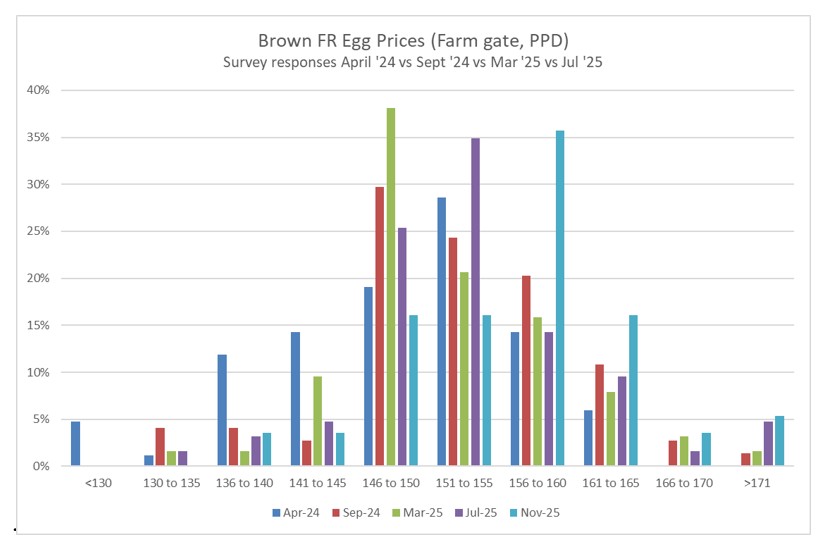
Using the same grade profile as the ADAS Cost of Production calculation, the reported mean average farm gate price is currently 155.6 pence per dozen (ppd), 1.6ppd ahead of the summer survey
According to your responses, two-thirds of farms are receiving between 148 and 160 ppd. While the highest reported price is unchanged at 184 ppd, the low-water mark has risen from 135 to 139 ppd. And a rising tide gathers (nearly) all boats, it seems. Even in a relatively small data set when compared with previous surveys, more farmers than ever reported receiving prices in excess of 160 ppd. Proportionally, now a quarter of the brown egg-producing community achieve prices that not long ago reflected supermarket shelf-front rather than farm remittance values.Private marketeers report mega-marginsAn unusually high number of members responded to say that they did not sell their eggs to a packer, and instead marketed them independently. Whilst the two paths do not make for a fair comparison in egg price, the insights into the potential value created and retained by some primary producers are welcome.There is seemingly little correlation between the privateer prices, with the lowest akin to a typical packer price and the highest in excess of £3.60 per dozen. It would be assumed that the lower prices reflect a transfer price between different parts of a business, whilst the higher prices perhaps tell only half the story, neglecting the costs of delivering the product to market.Nonetheless, at £3.60 or more, the independent marketeer should be commended for selling at prices above Waitrose and Marks & Spencer.Feed prices continue to slideWithin a pound, our survey mirrored the independent data collated by ADAS, with the average feed price reported at £295 versus £294 in the latest published costings (November edition). That is a saving of £4 against the July survey. The range, as ever, is considerable.We’ve reported in previous commentaries that there is a North–South and East–West divide, and it’s on show again this time. Farmers supplying Eastern county packers such as Fridays, Havensfield and Anglia Free Range appear to enjoy feed prices up to £80 per tonne below farms in Scotland, or at least those supplying Scottish packers.
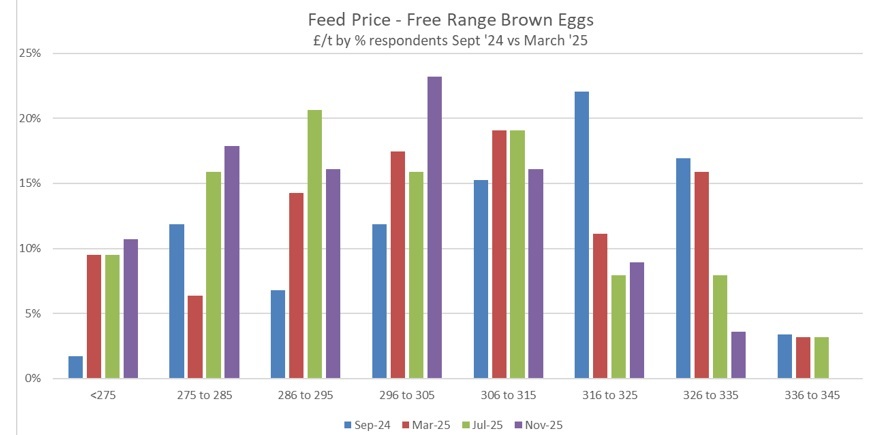
Within a pound, our survey mirrored the independent data collated by ADAS, with the average feed price reported at £295 versus £294 in the latest published costings
The lowest feed price reported was £248/t, but as the chart below indicates, there is a growing proportion of respondents paying less than £285/t – nearly 30%, in fact. And this is reflected at the higher end of the price spectrum, with fewer farms reporting prices north of £325; down to 5% from 13%. The highest single price was £330, although a few months ago it was £348.Good news for marginsWith feed prices down and egg prices up, gross margins are rising. The crude measure we use takes £5/t as equivalent to 1 ppd, as is the old rule of thumb. From an average margin over feed of 94p in July, the dial has nudged closer to a pound.Whereas a quarter of respondents achieved this magic marker last time out, nearly a third today enjoy such a margin, even excluding those marketing their own.The message to producers is an obvious one: it’s important to look at both revenue and cost lines to ensure that your business performs as it should. There may be valid reasons why your egg price is higher or lower than others, and recognition of an equivalent variance in feed cost may be one. Paying a high price for feed while being stuck on a low egg price, however, is to be avoided.In the most general of terms, those achieving the highest overall margins are not just benefiting from a very high egg price or very low feed price, but both. The end result is that the top 10% of businesses are earning 27 ppd more gross margin than the bottom 10%, or 32% more.Lack of responses for OrganicRegrettably, and for the first time, it is not possible to draw conclusions from the respondents representing organic production. To the three farms that took part – thank you. To the others: where have you gone?For the sake of those who did reply, the highest egg price yielded a weighted average of 259 ppd, and although this person stated that they market their own, their quoted price for the top three grades was actually below a packer-paid price received by the second farm. It is only in the seconds and smalls that the direct marketeer made back their headline advantage, equating to a 5 ppd benefit overall.The lowest price equated to 225 ppd, and in the case of large and very large, they received prices some 50 ppd below the others. Feed prices ranged from £566 down to £480/t. A health warning: a small data set makes meaningful comparisons impossible.Round-up and final messageA few final statistics. Only three respondents indicated a flat egg price, where farm and graded seconds received the same price as all Class A sizes. Are such deals drying up?Contracts linked in full or partially to cost of production hold steady at around half of replies. White egg production returns were higher but, at 9%, still below the chick placement estimates of 12% market share. The average price for white egg was exactly a penny higher than brown, at 156.6 ppd. Again, caution is urged over a small sample set.Over the course of the last three years, the share of product value returned to the farm has increased markedly. In December 2022, Tesco sold 12 Large free range eggs for £2.55, and the producer received on average 91p for their eggs – just over a third of the shelf price. Today, the same pack retails for £3.25 but the farmer keeps nearly half of the value.Supply and demand pressures can take some responsibility for this, but the efforts to be balanced and transparent in the reporting of margins and community pricing have also played an important role. Your support is a crucial part of our ability to continue this work.It’s no longer a case of suspecting that the grass may be greener, or that the business next door is on a better deal. Now you know. And if you’re not receiving your fair share or not achieving the yardstick for typical farm gate prices, you’re armed with all the information necessary to do something about it.That has to be worth five minutes of your time to complete a survey every few months.