

AVEC’s Birthe Steenberg Urges Sector to Set the Agenda
Published on : 25 Feb 2026
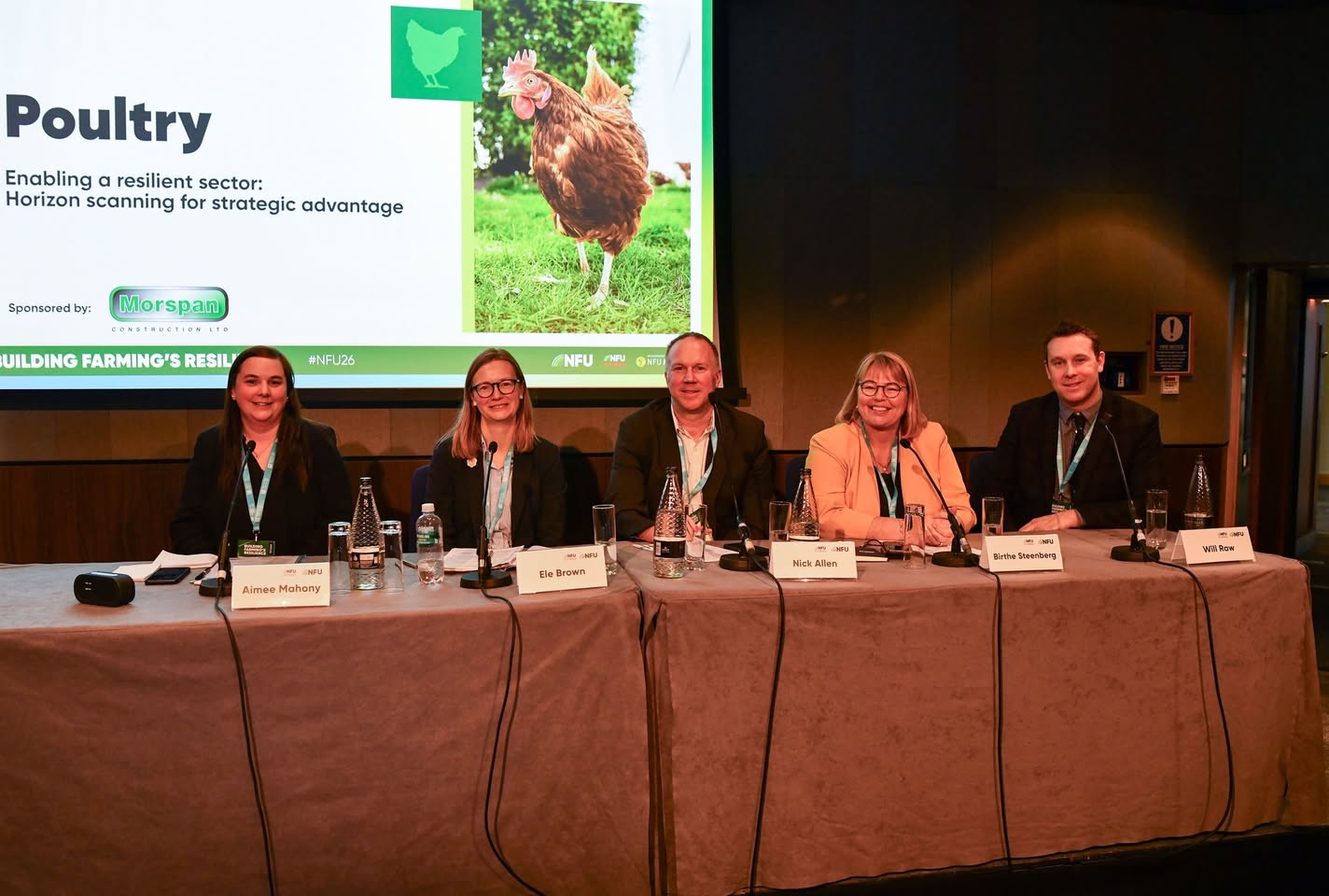
Beth (second right) was particularly forthright on the issue of trade barriers linked to vaccination
Birthe Steenberg brought a distinctly European perspective to the NFU Poultry breakout session, and her contributions proved among the most direct and strategically challenging of the afternoon.As Secretary General of AVEC, representing the European poultry processing and trade sector, Steenberg’s focus was firmly on positioning, political engagement and the importance of taking control of the narrative rather than reacting to it. While much of the discussion centred on firefighting, she repeatedly returned to one central message: the poultry sector must move from defence to proactive strategy.On avian influenza, Steenberg was unequivocal that vaccination cannot be approached in isolation. She argued that because migratory birds and trade flows ignore borders, any meaningful vaccination strategy must be coordinated at least at European level and ideally globally. A fragmented approach, she suggested, risks undermining both disease control and trade stability.She was particularly forthright on the issue of trade barriers linked to vaccination. In her view, it is no longer credible for countries to resist vaccination because of export implications while at the same time demanding high welfare and biosecurity standards. She stressed that the risk of viral mutation, including the potential for human health implications, makes inaction unacceptable. At the same time, she warned that surveillance comes at a significant cost and should not be treated solely as an industry burden. Avian influenza, she said, is a societal issue, and governments must recognise their responsibility in funding and supporting disease monitoring frameworks.Steenberg also addressed welfare and consumer perception, challenging assumptions that survey responses equate to purchasing behaviour. Drawing on European data, she highlighted the gap between what consumers say they support and what they actually pay for at the checkout. While high percentages may claim to want improved welfare standards, willingness to pay significantly more remains limited. For policymakers, she implied, this disconnect must be acknowledged before mandating structural changes that may undermine affordability.Her most striking intervention came during discussion of NGO pressure and industry engagement. Rather than encouraging confrontation, she advocated strategic engagement. Invite NGOs into industry forums, she suggested. Identify areas of common ground, particularly on import standards where alignment may exist. Attend parliamentary discussions even when not formally invited. In her view, disengagement only allows others to define the agenda unchallenged.She illustrated this with an example from Denmark, where poultry producers opened their operations to public scrutiny through live camera access. The result, she said, was overwhelmingly positive public feedback, with only a small minority remaining critical. Transparency, she argued, disarms suspicion and builds confidence.Steenberg was equally candid about political realities. Across Europe, she noted, ambitious animal welfare reform proposals have stalled under the weight of amendments and competing priorities. Policymaking is complex, often contradictory and rarely linear. For that reason, she urged the sector to engage early and shape policy rather than respond once proposals are already formed.When asked what she would prioritise if in political office, her answer was practical: fix planning and permitting barriers that prevent investment. Without the ability to build and modernise, strategic ambition remains theoretical. She also encouraged the UK sector to use its current momentum, including rising poultry consumption and political attention, to present its own roadmap rather than waiting for government to produce one.Throughout her contributions, Steenberg’s tone combined realism with encouragement. She acknowledged the pressures facing UK producers but consistently returned to the importance of visibility, communication and unity. The sector, she suggested, has much to be proud of in terms of standards and performance. The challenge is ensuring that pride is translated into influence.If resilience was the overarching theme of the session, Steenberg’s message sharpened its meaning. Resilience, she argued, is not only about surviving shocks. It is about political literacy, strategic communication and the confidence to set the terms of debate rather than merely respond to them.