
Labelling
Published on : 16 Mar 2022
The English, Welsh and Scottish governments have agreed to pass legislation allowing egg producers to keep their free-range marketing status indefinitely when a Housing Order is announced by their respective Chief Veterinary Officer (CVO). We will let members know when this happens, but, in the meantime, existing rules apply. This means that producers can only house their hens when instructed to do so by the CVO, and the 16-week rule will currently apply.
GB-wide Information Note from Defra on the Marketing of Eggs from Hens Temporarily Housed in Barns for their Welfare from 21 March 2022
Purpose and scope
To enable a consistent approach to concessions on compliance with Egg Marketing Regulations across GB (England, Scotland and Wales) from 21st March 2022 whilst the Avian Influenza housing order is in place. Separate information will be issued by DAERA to cover Northern Ireland.
Background
Following the introduction of the Avian Influenza housing order across the United Kingdom on 29th November 2021, an Avian Influenza Prevention Zone is in place to reduce the risk to poultry from AI. The Prevention Zone requires industry and other poultry keepers to implement higher biosecurity measures in their flocks specifically by housing or separation of all poultry from wild birds. A fixed 16-week ‘grace period’ exists during which eggs from birds which were intended to be free-range may be marketed as free-range even though they are housed. This grace period expires on 21st March 20221.
The marketing of eggs as ‘free-range’, when they are not entitled to use that designation because hens have been housed beyond the 16-week grace period, would be a breach of legislation: instead, the eggs should be marketed as ‘Barn Eggs’. Accordingly, if birds remain housed beyond the grace period, producers must amend the marketing of eggs in order to comply with the law. The law requires that an indication of the farming method must appear on the outer surface of packs containing the eggs in easily visible and clearly legible type.
Egg marketing from 21st March
Legislation on Egg Marketing Standards (in retained Commission Regulation (EC) No 589/2008) sets out the rules for producers to follow in indicating the farming method, if a mandatory requirement to house birds (such as a housing order) prevents hens’ access to open air runs beyond the 16-week grace period. These standards already provide a significant period during which the free-range description may be used to market eggs even though the hens are housed.
The following additional arrangements for marketing eggs will apply from 21st March 2022:
Egg stamping
From 21st March, egg producers are required to ensure that eggs are stamped with the appropriate code to show that the farming method has changed from ‘free-range’ or 1UK to ‘barn’ production or 2UK, until the mandatory housing requirement is lifted. Given that eggs cannot be stamped with two different codes, the Government welcomed BEIC’s temporary derogation to the Lion Code of Practice to allow the usual on-farm marking of Producer Establishment Number to take place in packing centres (see footnote 2).
- The grace period expires at 00:00:01 hours on 21st March.
- Local Egg Marketing Inspectors/Poultry Officers should be contacted if producers have issues accessing egg stampers.
Egg box labelling
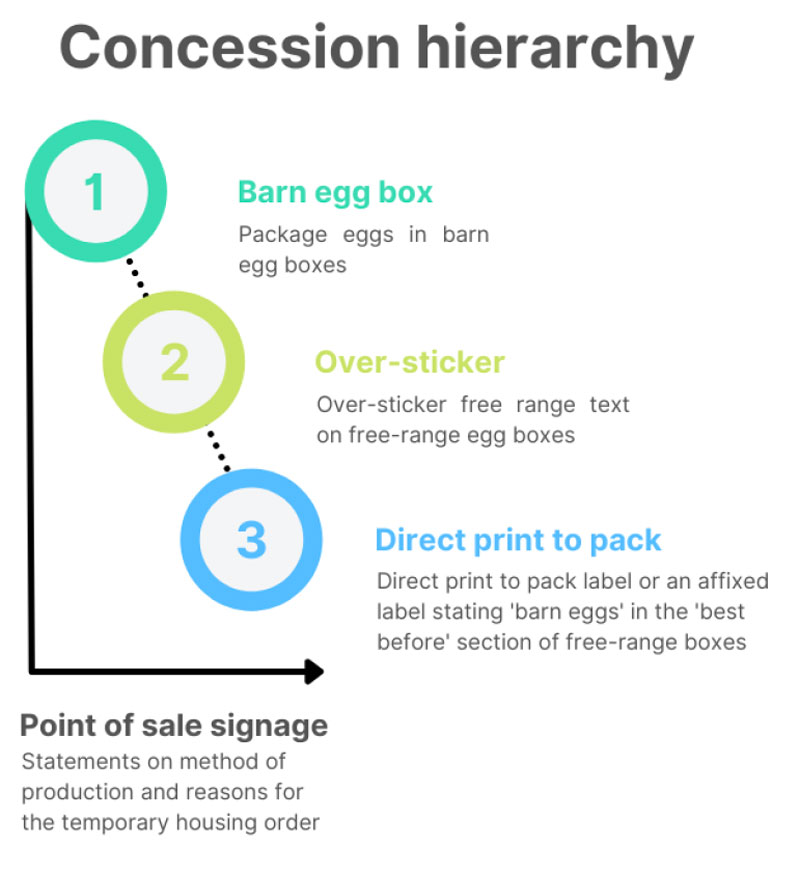
Industry must put in place one of the agreed options for marketing eggs laid on or after 21st March (Appendix A and B). These are, in order of preference:
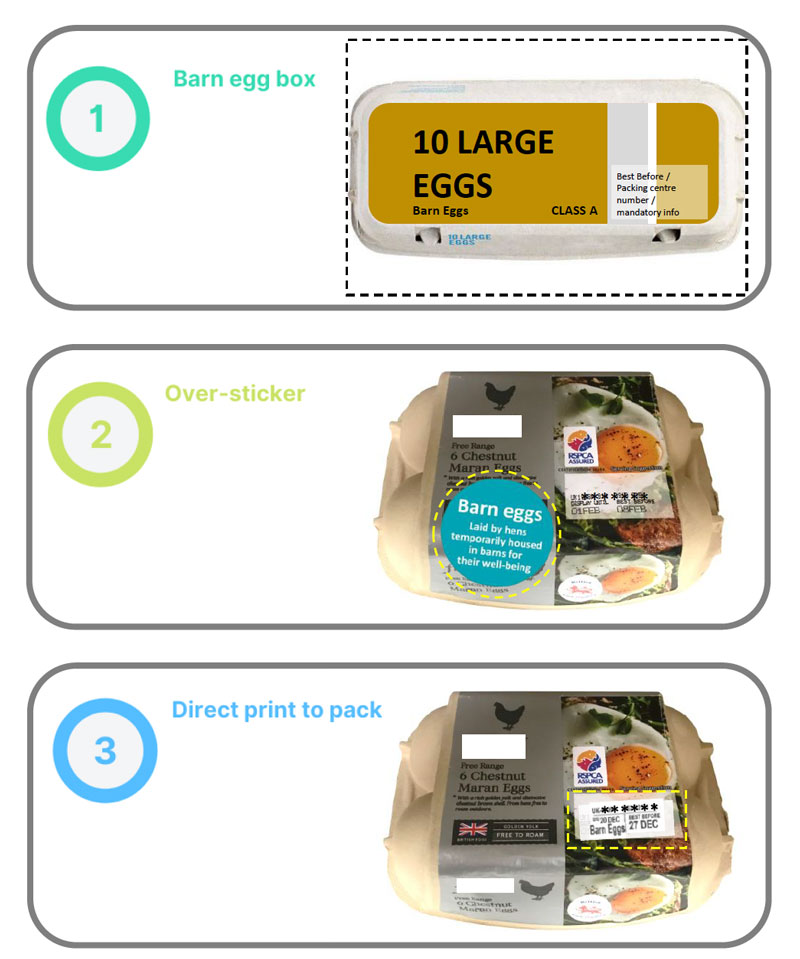
- Eggs are to be sold in “barn egg” boxes in order to clearly display the farming method of the eggs.
- “Over-stickering” free-range boxes by placing a sticker over the “free-range” text in order to obscure or interrupt it leaving the correct farming method (“Barn Eggs”) easily visible and clearly legible to the consumer. The over-lay sticker must be of suitable material to be affixed to allow for good adhesion and to prevent any labels dislodging before sale to the final consumer.
- In recognition of the challenges of Covid-19 and supply chain issues facing the industry, a further concession is granted to allow the use of direct print to pack or an affixed label on free-range boxes where the words “Barn Eggs” are included in the ‘Best Before’ section for domestic sales. The words “Barn Eggs” should be easily visible and clearly legible. This is the minimum option agreed for the current AI outbreak.
The Governments across GB (England, Scotland and Wales) have made these concessions for this year only on the understanding that once the national housing measures have been lifted, a more suitable approach to handling future outbreaks is agreed.
Northern Ireland
Northern Ireland will issue separate advice to industry. Labelling for eggs moved from GB to NI should follow the guidance for NI.
Point of Sale (POS) Signage
Clear and transparent POS signage is essential to ensure consumers are not misled, and to avoid undermining consumer confidence in the free-range industry. When a direct print to pack label or an affixed label is used to market eggs, POS information is mandatory.
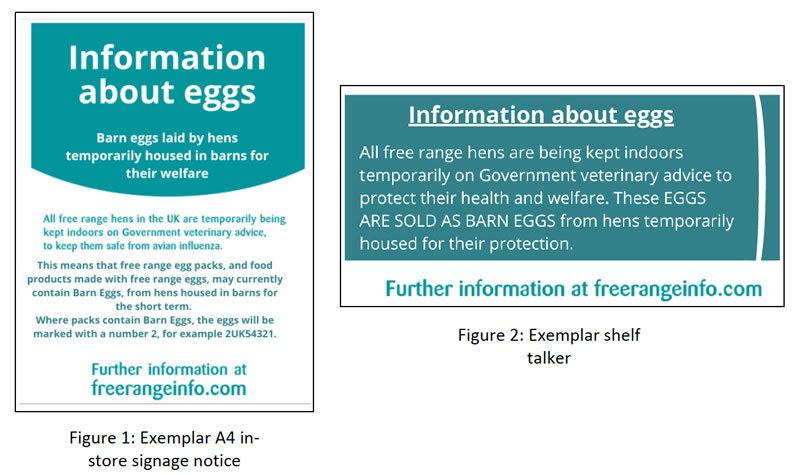
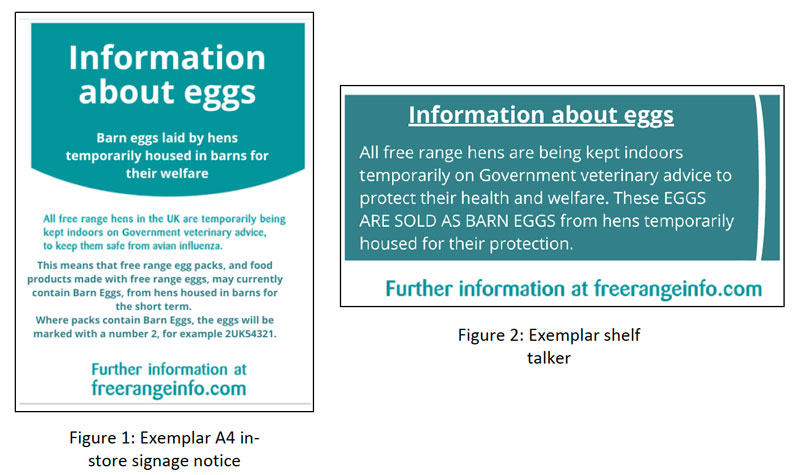
POS signage should clearly state the method of production and the reasons for temporary housing. (Exemplar POS material is included in Appendix C.) The egg industry must work in cooperation with its retail customers to ensure that consumers are made fully aware of the status of these eggs before purchase. The sufficiency of a notice or sign and the adequacy of its location will be determined on a case-by-case basis.
From 21st March, the minimum standard for POS and in-store signage should be:
- On the eggs fixture, a shelf talker placed with the price point on each stock-keeping unit (SKU) of free-range eggs affected.
- A detailed consumer notice in the egg area. There needs to be equal prominence given to ‘Barn Egg’ and any ‘Free-Range’ wording. This will ensure that consumers looking to buy free-range read POS information, whilst also explaining to consumers that eggs will be Barn Eggs from 21st March until the hens are no longer housed. Exemplar statements to be used in POS and in-store signage are included in Appendix C.
- Additional information on the housing order and temporary marketing changes online, in-store and at point of sale for delivered goods.
- Additional in-store signage, including in areas that include free-range eggs as ingredients (provisions aisle, mayonnaise aisle), to alert consumers to the temporary situation.
Key words to be used in POS comms are:
- Relates to all hens
- In door
- Barn Eggs
- Temporarily
- For welfare
- Supporting British Farmers
- Government (to be used in the context of ‘we are following Government Guidance, advice, set direction, etc).
These words should also be used in statements in retail stores, websites and the out of home sector (e.g. cafes and restaurants).
Online sales
For online sales, statements should appear on website home pages, on banners in egg taxonomy pages and when customers search for eggs. General information pages and Q&A sections of websites should also include information on the current Avian Influenza outbreak (Appendix D).
Egg as an ingredient
A list of ingredients on a pre-packed food product will contravene retained Food Information to Consumers (FIC) Regulation (EU) 1169/2011 if it indicates that it contains free-range eggs, when the eggs should be classified as Barn Eggs, unless corrected.
Should a free-range indication be given on a list of ingredients, the use of a clear correctional notice or sign in a suitable location will be sufficient to correct a ‘free-range’ reference.
Appendix A: GB-wide Concession hierarchy outlining how industry should market eggs laid from 21st March.
Appendix B: Illustrative examples of the concession hierarchy outlining how eggs should be marketed from 21st March.
Appendix C: Exemplar point of sale (POS) and in-store signage examples.
Appendix D: Exemplar website copy
You may be aware of the current temporary requirement from the government for all UK farmers to keep birds being bred for meat and eggs indoors as a precaution against Avian influenza. The Food Standards Agency and Food Standards Scotland have jointly said it poses a very low food safety risk for UK consumers.
We remain committed to our usual high standards of animal welfare and to supporting our British farmers during this time. Our free-range poultry and hens will be permitted to access outside space as soon as it is safe to do so. In the meantime, these animals are classed as barn poultry and hens.
Temporary housing order: eggs and poultry
You may be aware of the current temporary requirement from the government for all UK farmers to keep birds being bred for meat and eggs indoors as a precaution against Avian flu.
Although Avian flu poses a very low food safety risk for UK consumers, the government is trying to limit the spread to protect both wild and farmed birds.
This includes a housing order across the UK which requires keepers of birds to keep them inside away from wild birds. This extends to all free-range poultry reared for meat or egg production, including when used as an ingredient, and affects all UK retailers and producers.
Animal welfare is a top priority and we will ensure that the highest standards of welfare are maintained while this housing order is in place.
All poultry have freedom to express natural behaviour, including perching and roosting while they are temporarily indoors.
Over the next few days you will see notices in our shops advising customers of this temporary change.
We are very much committed to free-range and to the farmers who produce our free-range eggs and poultry. This means selling only free-range eggs and using only free-range eggs as an ingredient in our own label products - and this will continue as soon as the temporary housing order has lifted. In the meantime, products labelled as free-range are derived from barn hens and poultry.